Handle Criticism with Grace
What’s more disturbing than when someone Tries to Cut YOu Down For NO Reason?

Being criticized can feel like such an unfair curse. You work so hard to stay afloat, and at any moment, someone can come along and pop a hole in your boat with a total lie. Especially when you’re not expecting it, the shock and anger are automatic. Your mind spins, as you try to figure what to do or how to make sense of the ridiculous thing they said.
You imagine the perfect comeback, or even plan ways to make them feel the sting you that you did. But then you either blow up or just avoid them. Even when you try to calm down and let it go, your mind keeps racing anyway.
So what does it take to bounce back quickly after being criticized, instead lashing out or shutting down?
Know Who You Are

It’s impossible to avoid criticism. Do something, and you’ll be judged for it. Do nothing, and you’ll be judged for that too.
Even if you retreat from the world and live in silence, you’ll end up criticizing yourself.
Criticism isn’t the problem. It’s the fear of criticism that should be avoided.
There are two ways to overcome this fear:
Make your mark indisputable
If the goal is to make everyone like you, then no matter how hard you try, all it takes is one critic to sabotage your efforts.But if the goal is to succeed, then let your work speak for itself. Build your legacy. Prove them wrong with your results, not your words. Carve the meaning of your life so deep into the stone that it can’t be removed by many critics scratching the surface. The fact that they care is a mark of distinction that you can be proud of.
You can even do socially by developing connections and relationships that are so substantial and deep, the critics don’t matter.
Develop integrity
Aren’t there things you believe in, regardless of what anyone else thinks? Don’t you try to live up to those ideals, regardless of what they say?
Clarify who you are, what you value, what you believe in, and what your purpose is. Then set yourself up to make choices in alignment with self-knowledge. Integrity depends on your choices, not on another people’s opinions. That’s why, the more you accept who you are, and feel good about your choices, the less it matters what random people think.
Notice when you feel offended
Handling criticism well doesn’t happen automatically. What happens automatically is lashing out in the heat of the moment, trying to bury it, or plotting the perfect comeback. So don’t be hard on yourself if you struggle. It’s normal.
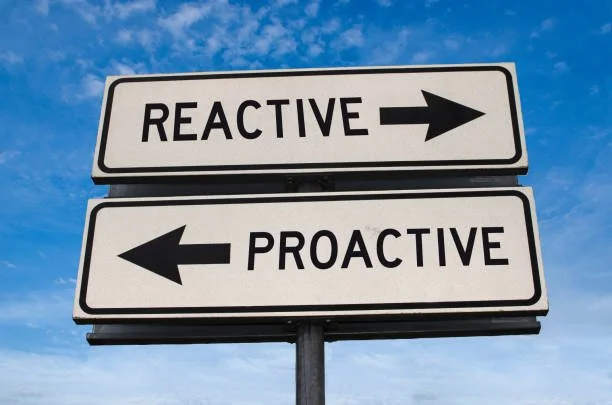
The first step is to interrupt your automatic reactions. This moment of awareness, at whatever point it comes, is the fork in the road where you can turn towards the more dignified path. So instead of getting carried away—just pause, notice that you feel offended. This is the beginning of being proactive instead of reactive.
Tend to Your Hurt Feelings

You might theoretically know that your self-worth doesn’t depend on being liked by everyone. But harmonizing your emotional reactions with that understanding is a journey on its own.
Human nature is such that humiliation is the last thing we want to feel. So when we do feel that way, we try to get rid of it by shifting the focus to blaming others. This can protect your sense of self in the short term, but it also traps you in resentment. Instead of healing the wound, you remain fixated on needing something from the offender first.
When someone criticizes you, it’s essential to acknowledge—at least to yourself—that your feelings are hurt, instead of spiraling into shame or blame.
Here are some ways to tend to the wounds from harsh words:
Take a step back
You are not your feelings and they won’t last forever.
Notice them, breathe through them, and give yourself space to be human.
Remember your humanity
Everyone gets criticized sometimes. So when it happens to you, it’s no proof that you’re uniquely flawed or singled out. It’s just part of life.
Seek healthy validation
Ask someone you trust or admire for feedback, instead of looking to people you don’t.
Encourage yourself
Learn your lessons without punishing yourself. Encourage yourself the way a friend would. Focus on moving forward positively instead of trying to change the past. Don’t let one fault cancel out all your other redeeming qualities. Be grateful for the opportunity to be alive, despite all the imperfections that come with it.
Examine your expectations

It’s important to make the expectations in your relationships are reasonable, impartial, and have been clearly communicated. Otherwise, if your expectations, or those of others, are unreasonable, self-serving, or unspoken, you’re setting yourself up for disappointment and frustration.
So ask yourself: What do you believe they should have done differently than saying what they said? What do they believe you should have done differently than what you did?
The answer to these questions will clarify exactly what the expectations are that were violated.
Next, run those expectations by three tests.
Reasonable: Many things we do have an effect on other people, and we all depend on our expectations of each other to function as a society. There are also established standards for all sorts of endeavors—like math, music or customer service—that make someone helpful or disruptive. That’s why people need to correct each other sometimes, especially in relationships, teams, and communities.
If everyone followed these expectations, would it strengthen how people work and live together—or would it undermine our social cohesion and progress?
Immanuel Kant said: “Act only according to that maxim whereby you can at the same time wish that it should become a universal law.”
Impartial: It’s important to be consistent, and not entertain double standards. Sometimes we expect other people not take it personally when we correct their behavior, but then we turn around and feel offended when they point out our mistakes. If you want people to take correction constructively, then model that same humility when the magnifying glass turns toward you.
Would this expectation be fair if it applied equally to others in your situation, no matter which side of the correction they were on?
Clear: Consider why they didn’t act according to your expectations. Either they blatantly betrayed your trust, or what felt like a betrayal was actually a misunderstanding, disagreement, or lack of communication.
Were your expectations clear, understood, and agreed upon? Was this done explicitly (by verbal or written agreement) or implicitly (through assumed social norms)?
Consider the Merit of Their Criticism

Some of the most valuable feedback you’ll ever receive comes wrapped in ugly packaging. A person might deliver it harshly, sarcastically, or at the worst possible moment—but if you can separate the message from the delivery, you might find something valuable inside that truly benefits you.
The “ugly packaging” is this instance is the judgmental, negative, and loaded language people use. The first questions you should ask yourself are:
What exactly did I say or do that the critic is focused on? How would an impartial observer describe that behavior?
This question helps you to remove the negative spin or interpretations, and just look at the facts.
Next, look for the values embedded in the criticism. If they called you “careless,” it must mean they value being careful. If they say you “talk too much,” it must mean they want more quiet or space for others to speak, or something like that. Ask yourself:
What are the positive values they think I didn’t fulfill? Do I share those values? Or is it at least something that’s necessary for cooperation or effectiveness?
If the answer is yes, then even poorly delivered criticism just revealed an opportunity for improvement. If not, then the value is meant for someone else.
You don’t need to thank someone for their criticism unless it was offered in good faith, delivered with respect, and genuinely benefited you. You don’t want to encourage bad behavior when you could seek the same insights from a trusted source.
Assess their Delivery
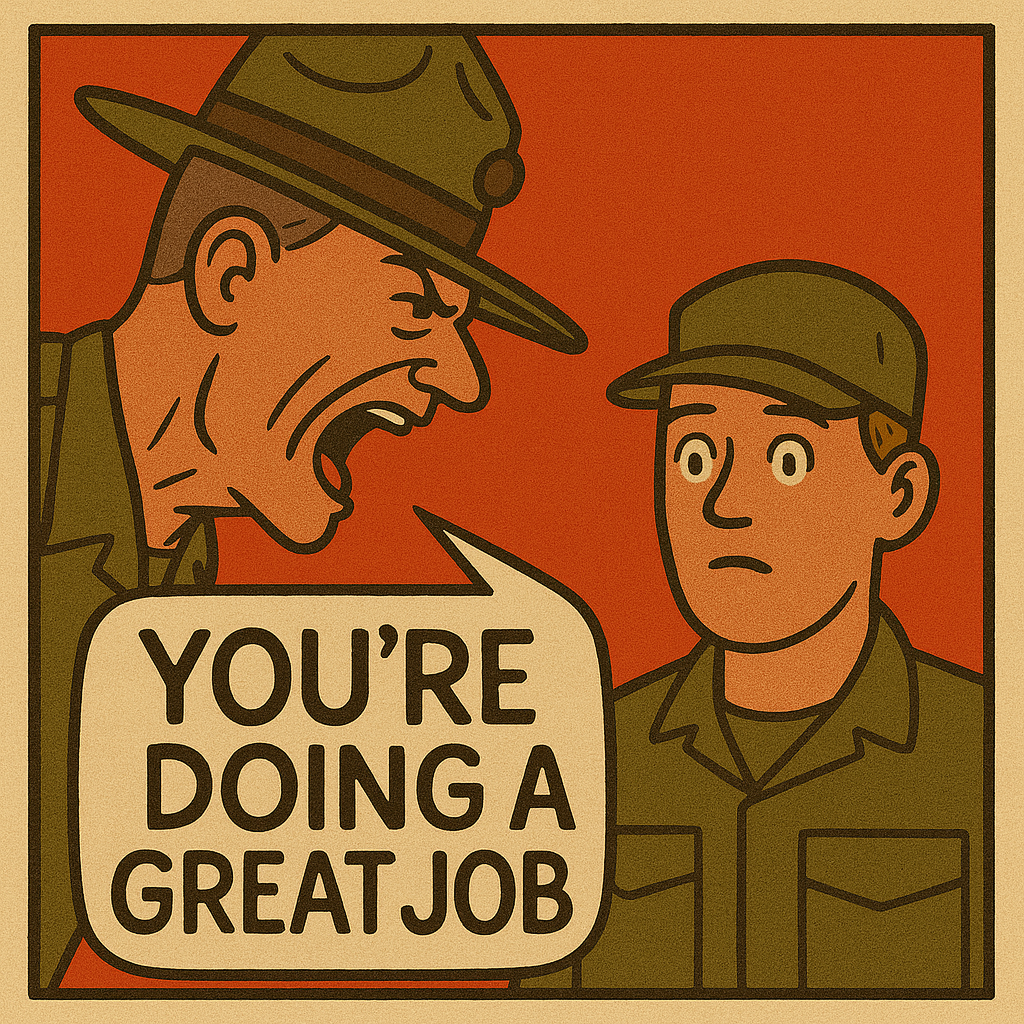
You can acknowledge that a message contained something useful, while also recognizing that the way it was delivered was inappropriate.
Did they speak with respect, or was their tone harsh, dismissive, or sarcastic? Did they correct you privately and directly, or did they criticize you behind your back or in front of others? Did it feel like their goal was to help, or to tear you down?
If the delivery failed these tests, you don’t have to ignore it. Telling them how you feel sets a boundary. It communicates that you’re open to feedback, but only if it’s given in a way that respects your dignity.
Take a Stand

When dealing with a critic, the best thing you can do is carry yourself in a way that signals self-respect. Lashing out uncontrollably or shrinking into submission signal weakness. Don’t show them that they have power over you.
You no longer depend on their apology, approval, or punishment before you can feel good about yourself. Either there are things you can work on, or their words glide off you.
If you’re interested in reconciliation, set clear expectations. Let them know what you would need in order for them to earn your trust back. Stand up straight, make direct eye contact, and speak with a calm confidence like you believe what you’re saying. Ask what led to their mistake and how they intend to change. Then allow them to earn back your trust through consistent action. If it’s about cooperating in your shared roles, treat it as a matter of community expectations rather than personal ones. Keep it formal, respectful, and professional. You might have to interaction with so many people in public or at work, but you don’t owe anyone a place in your private life unless they’ve proven that they deserve it.
Of course, they might disrespect your expectations—and they have the right to make that choice. But you also have the right to decide what kind of relationship they can have with you. You can still treat them with basic respect, but you don’t have to offer closeness, trust, or loyalty unless they’re willing to respect your boundaries and meet the expectations that come with their role. You’re not giving them an ultimatum, you’re just letting them know the price of entry. And there’s no pressure. The choice is theirs.
Final Reflection

In the wild, crows sometimes attack eagles. But the eagles never waste time trying to fight the crow. Instead, they rise higher and higher into the sky, until the crows can’t breathe at that altitude and have to let go.
That’s what true power looks like. It isn’t getting angry or making demands. It’s having control over yourself, and demonstrating your dignity through action. The eagle’s self-worth isn’t shaken by the crow’s criticism. It doesn’t need revenge or applause. It just continues up higher and higher.
None of us has perfect patience, but we can learn how to get back on track when criticism gets under our skin. It starts by accepting that criticism is an inevitable part of living in human society, and choosing to rise anyway.
When you feel offended, take a break and tend to your own wounds first. Make sure the expectations are reasonable and impartial, and then take a stand with calm strength.
Ultimately, the destination you should aim for is far above the clouds of blame and praise, where you accept who you are and believe in your contributions, even if others don’t. Wherever you are on this journey, every step forward makes you more secure and connected person.

Skeptical of Life Coaches?
Are you skeptial of life coaches? It’s good to be cautious!

Some years back, an old acquaintance moved into our area. He showed up just enough at community gatherings to invite you to his home—where he’d serve you gourmet food, make you feel like the most interesting person in the room, and casually drop hints about his seven-figure success story.
I thought I knew him. I thought that meant I could trust him. So when he pitched me on a $10,000 coaching program, I told myself he was either a scammer or really confident—and decided he must be the latter.
What I got for my $2,000 deposit was a few amateur videos and weekly Zoom calls where he taught high-pressure sales tactics that made me sick to my stomach. The realization I’d been misled didn’t hit all at once. It crept in as a quiet dread, then solidified when friends started calling with their own horror stories.
I wish I could tell you I spotted the signs from a mile away. I wish I could say I knew all along he was a skilled scammer but an amateur coach. But I didn’t. I let my guard down, acted out of urgency, and made an emotional decision despite the risks.
And that’s the scary truth: anyone can be scammed and not even know it. It’s not about being gullible, it’s about being human. Scammers don’t depend on “foolish” people. They depend on normal instincts like trust, urgency, and hope—the same instincts that make us open to real opportunities.
The worst part is, scams like this don’t just hurt the people who fall for them. They stain the entire coaching industry. One person’s greed can cast a long shadow over hundreds of skilled, ethical coaches who are doing the work for the right reasons.
But don’t worry. We’ll discuss how you can protect yourself from being taken advantage of by bad coaches. But first let’s consider what makes someone a “bad coach.”
What makes a good coach different from a bad one?
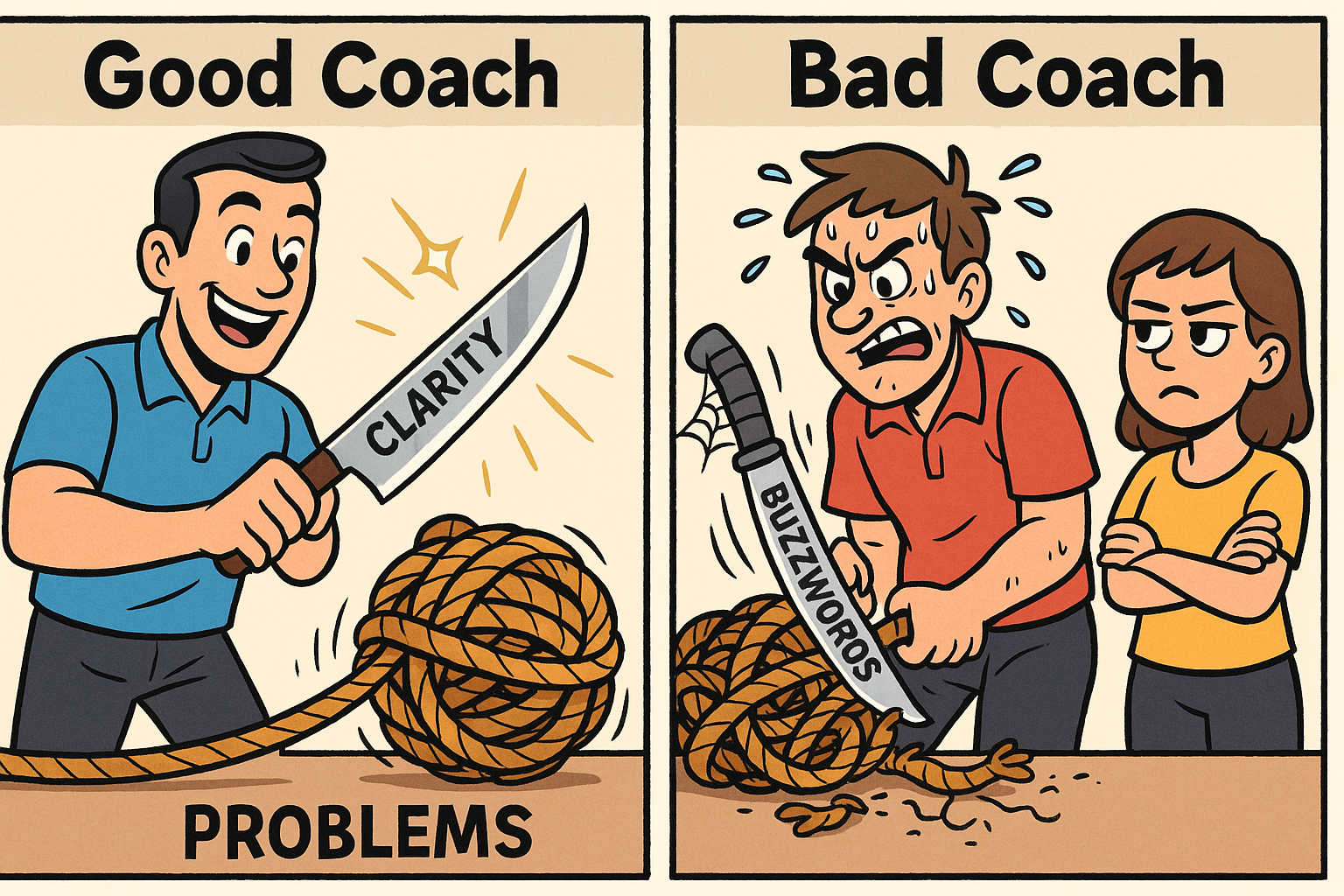
Abraham Lincoln said, “Whatever you are, be a good one.” This is an idea that goes all the back to Socrates, Plato, and Aristotle. It’s called it teleological ethics. Basically, everything in this world serves a purpose, just like a knife is meant to cut. What makes something good, therefore, is when it serves that purpose well—like when a knife is sharp, that makes it a good knife.
Similarly, the purpose of any life coach is to make a positive difference in your life. If they can make that difference—as long as you do your part, too—then they’re a good coach. But if they can’t make that difference, what does it mean? First of all, it doesn’t necessarily mean they’re a bad person. They might have a lot of redeeming qualities that attracted you in the first place. But they’re not qualified for the role they’ve assumed. And it’s not a good sign that they don’t realize or admit that! They’re either intentionally deceiving you, or they don’t know what they don’t know.
Sales and marketing are important skills that help life coaches connect with new clients. But gaining clients doesn’t automatically make them qualified to actually help them! That’s why sales and marketing skills aren’t the qualifications that determine the difference between a good coach and a bad one. What really makes a good coach different from a bad one is what happens after you sign up.
A good coach:
Is a master of their craft.
Puts your interests above their profits.
Uses a framework or process that can stand up to scrutiny.
Makes sure your interests are aligned with their offer before you commit.
Empowers you to gradually stand on your own two feet.
A bad coach:
Can’t deliver results.
Puts their own profits first.
Makes things up as they go.
Pressures you to buy.
Keeps you dependent.
The same standards apply to coaches who train other coaches. If they teach coaches how to master their craft and find clients, then they’re helping them develop both integrity and success. But if they teach only sales and marketing, assuming or pretending that their students are automatically qualified to help others, it’s just a pyramid scheme:
An endless chain of coaches coaching coaches to coach coaches. No thanks!
Filter out the scams and amateurs.
I don’t waste time debating with scam coaches or amateurs anymore—I just walk away. And you should, too. But first, you need to be able to spot them. Everyone needs a filter to separate real professionals from manipulative pretenders. Over time, I’ve refined a simple 5-part filter that I now run every coach, mentor, or program through before I invest a single dollar or minute of trust.
1. Check Their Reputation.
Just because you don’t see complaints on their official platforms doesn’t mean they don’t exist.
🔍 Check outside sources like reviews, forums, and community groups.
🗣 Ask discreetly by contacting past clients or mutual contacts.
2. Figure out how their program works.
Just because someone’s really nice doesn’t mean they can help you.
🧠 Ask them how their program works, and how exactly it will help you.
✅ Look for clear steps, measurable results, and real testimonials.
3. Look at Your other options.
Just because you have an urgent need for change doesn’t mean they’re your only option.
🔍 Explore your options.
❌ If they take offense and turn up the pressure, walk away.
4. Compare their prices to industry standards.
Just because someone charges a ton of money doesn’t mean they’re worth it.
🌱 Start small, and only invest more if they deliver.
5. See how they make you feel.
Just because they’re confident, doesn’t mean they’re giving you good advice.
✅ Sessions should make you feel clear, confident, and motivated to grow.
❌ They shouldn’t make you confused, pressured to spend more, or isolated from other perspectives.
Here’s my promise to you.

If you’re considering working with me, I want it to be because you we’re building trust and aligned in serving your interests, not because you were swept up in the moment.
That’s why I’ll never rush you into a decision, act like I’m your only option, or expect you to go all in from the very beginning. I’ll never lock you into something you can’t afford, and I’ll never make you feel bad for asking me challenging questions.
Instead, I will show you my commitment to excellence in serving you personally. And you can take your time, ask me anything you need to, and see for yourself how my program works before you commit. That way, you’re not just taking my word for it. We’re building a foundation of trust so we can make that positive difference in your life!
Trust, when placed wisely, allows you to grow.
Now that you know what to watch out for, it’s worth remembering that caution doesn’t have to be the end of the road for you. Caution is a mindset to help you avoid the scams out there. But if you reject all help just to play it safe, you might miss out on just the opportunity you need. Caution is limiting by nature. But the whole reason you’re considering coaching in the first place is because you want to grow.
At the end of the day, trust begins with yourself. You need to reach a place where you can trust your own judgement in someone else. So if you’re confident in your own judgement, then move forward without hesitation.
But if you’ve been misled before, like me, or you worry about talented scammers taking advantage of your unconscious instincts, follow the principles I laid out above. Test out the waters before you dive in. And take your time. Just don’t wait so long that unresolved issues are causing more problems than you’re avoiding by not finding able help.
Trust, when placed wisely, allows you to grow. It is expansive by nature, because it allows you to connect with people who can benefit you. A good coach helps you to clarify what’s important to you, so you have a positive foundation to make meaningful changes in your life. They help you see the unconscious beliefs and fears that are blocking your progress. They hold you accountable, so you can feel like your choices matter and learn from mistakes. And they encourage you when you’re having a hard day.
In these ways, trusting a good coach can be a real gamechanger in your life.

Waiting for an Explanation After Heartbreak
Waiting for an Explanation After Heartbreak
3 Steps to Find Closure After Heartbreak
By Damodar Roe

Waiting for an apology can feel like you’re drowning. Drowning in the raw ache of being discarded, while the one person who can actually throw you a lifeline casually walks away. You can’t understand it. You can’t accept it. You don’t know if this is actually real, and the uncertainty is killing you. It’s like suffocating. All you can think about is how to reconnect, how to finally catch your breath. So you call. You text. You try to corner them somehow, hoping for at least an explanation.
Maybe they respond, maybe they don’t. But something’s changed, and you can feel it in your bones. The warmth they used to have is gone. In its place is a hollow politeness, a distance too sharp to ignore. You try to clarify what happened, but they just change the topic, talk around it, or flat out deny the truth. Until the politeness begins to fade. The messages get shorter, the tone colder. It’s like your deepest feelings are just a burden, and you’ve gone from feeling chosen to feeling like an embarrassment they’re trying to erase from history.
You try to move on. Friends tell you to just let it go. But something inside you still feels… unsettled, hurt, broken. After all, you gave your heart to this person. And what did they do? They stomped on it, threw it away, and walked off like it never meant anything. You didn’t just lose them—you lost the connection you trusted, the future you pictured, the version of yourself that felt valued in their presence. How are you supposed to “forget” that? You wish you had the luxury to forgive, forget, and move on. But that kind of peace feels overly idealistic when the wound is still wide open.
You keep hoping this isn’t real. That it’s just a misunderstanding. Some twisted test of how much you care. You tell yourself maybe they’re just confused, scared, overwhelmed—anything but disenchanted. Maybe you can fix it. Maybe they just need time. Maybe they’re waiting for the right moment to reach out, to say they’re sorry, to admit they were wrong and they still want this. Maybe they’ll realize what you had was real.

But the longer the silence stretches, the more that hope starts to rot. You’re tired of being blindsided by someone who once promised they cared. You don’t deserve to be ignored until you start questioning your own sanity. You don’t deserve to be denied even the decency of a final conversation. So the heart ache turns bitter. What was once love starts to calcify into something more protective—something that says, “If you can’t see the truth of what we’re meant to share, then I’ll be the one to hold onto the sacred memories we have together that prove it. And if you still don’t care, then maybe I’ll make you feel my pain. I’ll make you hurt, too.” You might imagine calling them out, exposing the truth, making them finally feel the weight of what they did.
You start pulling apart every memory, going through every detail of every interaction. What happened exactly? What did it mean? Why did they do that? The more you analyze it, there are moments when you start questioning yourself. Did you do something wrong? Were you just not good enough? Despite so much investigation, you only feel more torn and tangled. Because deep down, you’re not just trying to understand what happened. You’re trying to understand what it says about you. Are you just too much? Or not enough? Does this mean you’ll always be rejected once someone gets to know you? Somehow, no amount of thought gives you the resolution you’re seeking, but the hope to find it keeps you going—hoping their actions will finally explain who you were to them… and who that makes you now.
One day you feel furious and you want them to hurt the way you’re hurting. But the next day, all you want is for them to call, to say it was all a mistake, and just fix it! You find yourself rehearsing both speeches—the angry one that ends everything, and the soft one that might bring them back. But you can’t stay on either side for very long. You bounce back and forth so fast, it makes you dizzy! And beneath it all is this gnawing, constant need to find something solid. Because what you’re really craving isn’t only justice or a second chance. It’s peace. It’s certainty. It’s finally knowing you’re safe again and good enough.
Success Story
When Alex came to me, she was heartbroken and unraveling. The man she loved had changed almost overnight. One day he was warm and promising a future. The next, he was cold, vague, and avoidant. She was spiraling, re-reading messages, and replaying everything in her mind to figure out what went wrong.
In one of our early sessions, I asked her a simple question:
“What would you actually need from him to feel peaceful again?”
She hesitated to answer. An apology? A second chance? Validation? She wasn’t really sure.
From there, the work shifted. We stopped focusing on him and started focusing on her:
What boundaries had she ignored to stay in that relationship?
What kind of connection did she actually want?
Was she confusing intensity with intimacy?
She began journaling every time she felt the urge to reach out to him, and we used those entries to trace the deeper emotional needs beneath her behaviors. Instead of trying to prove she was worth loving, she started asking, “Does this relationship even match the future I want?”
Eventually, she stopped chasing clarity from someone who couldn’t give it to her, and instead, she created it for herself. She grieved the loss of the fantasy, and committed to building a life that didn’t revolve around emotional guesswork.
By the time Alex met someone new—a grounded, emotionally available man—she wasn’t waiting to be chosen. She was in a position to choose. And that made all the difference.
Finding Peace Without Their Permission

What if closure isn’t something your ex gives you, but something you claim for yourself?
You don’t need their apology to know that you were honest. That you showed up. That you felt deeply and gave something real. The ending doesn’t erase the truth of who you were. And it doesn’t mean the connection was fake just because they couldn’t honor it like you did. Some people walk away, not because you were unworthy, but because they wanted something else in life, or were unwilling to rise to the occasion.
Closure begins when you stop waiting for someone else to decide what you’re worth.
It begins when you realize: They’re gone. But you still matter. And even though you’ve been heartbroken, it’s created an opening to plant something new. Its not about proving yourself to them. It’s about not abandoning yourself in the aftermath of being abandoned by someone else.
How to Reclaim Your Center
It would be wonderful if you got the apology and explanation you deserve. But sometimes, holding onto that hope can keep you emotionally stuck and tormented. That’s why it’s wise to remain open to the possibility of receiving an apology, but never wait for it. Never depend on it. Because you don’t need it to find the closure or peace of mind that you need.
Here are 3 Steps to Find Closure after a Big Disappointment:
1. Name the fantasy that you’re grieving
Sometimes what hurts the most isn’t the person or relationship you lost, but the crushed hope for what it could have been. Sometimes it’s even the version of yourself you that longed to be in that relationship.
Write down what you hoped the relationship was meant to be. What future did you picture together? What role did you hope they would play in your life? Who did you hope to be for them?
Now take a step back and look at what you wrote—as if a friend handed you this same vision. Would you say they were building that dream with someone capable of meeting it, or projecting it onto someone who kept pulling away? Was their hope growing from reality, or clinging to potential?
Sometimes what we’re chasing isn’t even a relationship itself, but a belief. It might be something like:
“If someone chooses me, I will finally feel complete.”
“If I can read them and give them exactly what they want, they won’t leave me.”
“Strong feelings means that the love is real.”
On your own, or with a mature well-wisher, identify the beliefs that are driving your attachment—not just to the person, but to what they represent to you. Then subject those beliefs to rational scrutiny and evaluate them on their own merit. Use your intelligence.
2. Turn the focus inward
Every time you feel the urge to reach out, pause, and use that moment to journal or reach out to a friend. You’re not weak for craving connection—you’re human. It’s okay to feel that way. It’s just that they’re not the one to reach out to anymore. So instead of chasing a person who’s walked away, investigate deeper into yourself. Connect with friends, family, and helpers. Clarity comes when you stop outsourcing your emotional needs to someone who’s shown you: they can’t meet them.
Instead of looking to your ex for answers, write your own narrative. It’s not about making them the villain, but reclaiming your own observations and perspective. What can you learn from this experience that will help you moving forward? Did you ignore your own needs, or stay silent about things that bother you, to just keep the peace? What would it cost you if you constantly put your feelings and needs last?
Instead of looking to your ex for validation, look to a mature well-wisher who can listen, ask questions, and offer you insightful feedback that you might have missed on your own.
Instead of looking to your ex for peace of mind, look deeper into your own life story to understand why they affected you the way they did. Did they stir up old fears or insecurities? Have you felt this kind of longing or rejection before? Who are these feelings originally related to? What did your younger self need in order to cope with these past traumas in a healthy way? How can you give yourself these things today? Who are some good helpers or support systems for you at this time? This pain may be resurfacing an older wound. And healing it now is your opportunity to stop repeating the cycle.
Instead of looking to your ex for hope, consider what kind of life you hope to build for yourself. What kind of relationship would fit with that? Then invest yourself in the hope and the proactive work to move in that direction. And if someone you meet is unsure, incapable, or unwilling to join you there, then that’s clarity—that’s not rejection or hopelessness. You can find someone who is ready, as long as you’re patient and proactive.
3. Make a New Promise to Yourself
It’s okay if you still miss them sometimes, doubt yourself, or have moments of resentment. It might seem like those feelings will permeate your mind and life forever, but just give it some time and stay positively engaged. You will start to have moments where you forget about them. And those moments will gradually get longer and longer.
What matters is giving yourself clarity about the situation, so you can respond to moments of self-doubt with self-compassion and courage. The goal isn’t complete freedom from suffering or a perfectly pure mind. The truth is that love is risky by nature, and it takes time to heal when your hopes don’t work out. But this doesn’t stop you from making the most of your life, reconnecting with friends and family, and even having happy moments.
Make this commitment to yourself each day:
I’ll build the kind of love I longed for,
starting with how I treat myself.

Thank you for reading!
The strategies in this article are rooted in a blend of established disciplines, including attachment theory, cognitive restructuring, self-compassion research, and trauma-informed coaching. You don’t need to understand those terms to benefit from them—but it’s worth knowing that these insights aren’t random advice. They reflect principles found in evidence-based practices like ACT (Acceptance and Commitment Therapy), IFS (Internal Family Systems), and even Greek philosophy.
Still, knowing what to do isn’t the same as knowing how to do it—especially when your nervous system is flooded, your mind is looping, and your heart still hopes for repair. That’s where support matters.
If this article spoke to your experience but you’re unsure how to actually implement these changes in your life, I can help. Whether you're caught in rumination, struggling to reclaim your self-worth, or simply ready to feel peace again, you don’t have to walk this alone.
I offer a free two-session consultation to evaluate your situation and develop a personalized success plan for you. So just reach out to me today and we can take the next step forward.

Rebuilding Trust After You Hurt Her
Hopeless, Resentful, and Full of Regret
Marriage and intimate relationships can feel impossible sometimes. You’ve tried everything to fix the situation, but nothing changes. And the longer this pattern goes on, the more it feels like nothing ever will. The situation seems truly hopeless. But you’re stuck anyway… in a situation you’re absolutely sick of tolerating.
You might have said or done things that you regret. Cutting words. Even physical attacks. Your moments of rage stem from feeling unheard, uncared for, and humiliated. But that doesn’t make it okay to hurt the people you love. So in the aftermath of your worst mistakes, you’re struggling with guilt, shame, broken trust… and even friends turned against you, and legal consequences.
Here’s what you might now realize though: Hidden beneath that rage is often a deep well of shame—the terrible feeling that says “I should be good enough for my family. But I’m not. I’m a failure, no matter how hard I try.” For men, this feeling is unbearable. We will do literally anything to avoid it. And it’s even stronger when you aim for flawless work, moral piety, and never letting people see you lose control. Finding yourself doing things that you swore you would never do, or that you outright condemned other people for, is truly devastating for your sense of self-worth.
So when you’ve tried everything—calm talks, compromise, pleading, pressure—and still nothing changes, your mind goes into survival mode. You get desperate: “If I can’t get through to her with words, then I’ll force her to understand. And if she still doesn’t get it, I’ll leave.”
It’s not that you want to hurt anyone. It’s that deep down, you feel desperate but powerless to fix the problem—and in that moment, rage feels like power. Especially as men, we want to be respected. We want to fix things. But when all our efforts fail, sometimes we resort to violence, in our words or actions, or to run to another situation where we don’t feel like a failure.
But rage isn’t power. It’s pain disguised as righteousness. And running away doesn’t solve any problems. It just reinforces the feeling of weakness. So what should we do?
The Serenity Prayer
Lord, Give me the serenity to accept the things I can’t change,
The courage to change the things I can, and the wisdom to know the difference.
Relationships are difficult sometimes. But you can make them worse than they have to be. This happens when you’re avoiding accountability, and focusing all the blame on your partner—when you have rigid expectations, take things personally, make assumptions about her intentions, and don’t control what you say. The source of feeling stuck and hopeless is trying to control what you can’t control—her decisions, perceptions, or choices… while neglecting to be honest and take responsibility for your own part of the equation. Stop trying to force a one-sided “solution” and prove you’re “right”, and seek a deeper understanding based on mutual respect. Hiding behind anger might help you hide some of the shame you feel, but it doesn’t make the situation better. It only makes it worse.
If you’re struggling in these ways, making every mistake in the book, it doesn’t mean that you’re a bad person. Most likely, no one ever taught you the skills you need to navigate these situations any differently. You’ve been doing the best you can with the tools you have—even though it’s unfortunately backfiring. The pain you feel is a sign you need to slow down, ask new questions, learn better ways of doing things, and gather the courage to try new methods. So don’t let shame drive you to rage or hopelessness. Instead, learn the skills that will help you succeed and feel valued. Work smarter, not harder.
Just like the Serenity Prayer helps us focus on what we can control, the skills you need will also help you to focus on what you can control—how you interpret things, how you communicate, how you listen, and how you see yourself. By developing skills in these key areas, you are reclaiming your control over what is naturally up to you. And by acceptingthat relationships are challenging sometimes, your partner can make her own choices, and the past is unchangeable, you are accepting what you cannot control. In these ways, by focusing your efforts where they’ll actually be effective, and accepting your natural limitations, you can transform your experience from hopelessness to tangible progress.
Find Meaning in Your Own Choices
When you’re hurt, your mind searches for meaning in every detail. A pause in her voice, a sharp look, a complaint said in frustration—your thoughts race to decode what it “really” meant. Was it contempt? Disrespect? Proof that she doesn’t value you? You replay the moment, building a case in your head. But the more you obsess, the more power you hand over to the very words and actions you resent.
The truth is, not everything others say or do carries the hidden insult your mind suspects. And even when it does, you don’t have to live in reaction to it. You can decide what meaning you’ll live by. Strength isn’t found in proving them wrong or exposing their unfairness. Strength is found in your freedom to choose what you stand for, and how you respond.
That doesn’t mean excusing poor behavior. It means refusing to let someone else’s frustration or blame define who you are. When your partner criticizes you, it’s easy to react with anger or revenge—to mirror the very unfairness that hurt you. But that path doesn’t bring the closeness you want. It only proves that resentment is still in control.
Instead, you can take ownership of the meaning. Ask: What matters more to me—the insult, or the opportunity to live by my own values? Sometimes beneath the criticism is a hidden need: for safety, for appreciation, for connection. By shifting from rumination to curiosity, you step out of the courtroom in your head and into a place where real understanding is possible. You don’t have to give them everything they want. But you can choose to see clearly, stay steady, and protect the dignity of both yourself and the relationship.
Your power isn’t in dissecting every slight. Your power is in intentional response—in deciding, moment by moment, to live as the kind of man who doesn’t need to win an argument to prove his worth. Meaning isn’t hidden in their words. Meaning is revealed in your choices.
Speak honestly without attacking
“Discipline of speech consists in speaking words that are:
truthful, pleasing, beneficial,
and not agitating to others.”
- Bhagavad Gita
Resolving conflict seems impossible when every time you speak honestly, the other person gets defensive. You might conclude they’re simply selfish, and that they’ve abandoned you in this relationship. This can happen. But you might also be contributing to their distance by speaking in a way that’s very difficult to stomach—with loaded language, personal insults, and one-sided narratives.
Some of the frustration and stuckness you feel comes as a result of not knowing how to speak in a way that’s honest, but also kind and beneficial. This happens when you only focus attention on the details of the situation that make you right and the other person wrong… or worse, when you twist the narrative to portray them as stupid or evil. Politicians are experts at this art, but no marriage counselor will ever recommend it. Instead, you need to learn how to share your experience without assuming it’s the only way to see things, talk about your feelings without criticizing, and express your needs without demanding.
Start by making “I” statements instead of “you” statements. This helps you to share what you feel inside yourself, rather than voicing your interpretations of what the other person is doing to you.
For example, when you speak out of anger you might say: “I work so hard to provide for this family, and you can’t even make dinner? What exactly do you do all day? I can’t even get any basic respect. All I need is a decent meal after work tomorrow, and you can’t even do that. I’ve had enough. Keep this up and I’m divorcing you.”
Instead, you can say: “I’ve been feeling exhausted lately—working long hours, holding a lot of my feelings in to show up and do what needs to be done. So when I come home and there’s no food or plan, I feel alone. It’s not just about the meal—but also what it means to me personally. Maybe you don’t attach that same meaning to it, and for you, it’s more of a practical situation. But I just want to let you know how this feeling has been building up in me. I want to know how you see it. And I want to work this out in a way that works for both of us.”
The key is to have a conversation that recognizes that you both have your own perspectives and experiences. Then you can open a dialogue that can actually go somewhere, rather than getting frustrated with fights that assume only one person can be right while the other must be wrong. It might be uncomfortable to talk about your feelings at first, but this invites your partner to understand you rather than defend themselves—and that opens the door for real connection. Certainly, that’s better than the pain you’ve been going through with endless, unproductive arguments, and uncontrolled outbursts of anger.
Listen to Understand, even when you don’t agree

Communication is challenging because we naturally focus on different things, interpret things in different ways, have different feelings about the same event, and what we want in the end is often different. Fights go nowhere when each person is entrenched in their own perspective, unwilling to even acknowledge the other person’s point of view. It’s like each person is moving farther away from common ground, and becoming more and more committed to a position that is adversarial by nature. I call this problem the ladder of misunderstanding.
Conflicts can only be resolved when you find some common ground. The first step down the ladder of misunderstanding, and towards common ground, is to ask thoughtful questions that invite a sincere conversation. Of course, your partner won’t always express themselves with honesty, kindness, and consideration. But that doesn’t mean you can’t guide the conversation in that direction anyway. For example, on a bad day she might say:
“I went out of my way to make dinner after a long, stressful day. I told you to be home by 5 for it. But you were late again, and I know why. You don’t want dinner. You just want to make demands for the sake of your huge ego, humiliate me, and waste my time. In fact, you never make time for your family. All you care about is work. Work! Work! Work! Work! But I’m sick of it. So either come home tomorrow by 5pm or I’m never making dinner for you again.”
Instead of reacting to the literal content of a message like, it’s often helpful to pause and reclaim your composure before responding. You can even excuse yourself for a few minutes, journal, or talk with a friend. But when you’re ready, respond with a question or observation.
Observation: It sounds like you’re stressed and fed up. It would mean a lot to you if I came home earlier. You want me to at least show up when I ask for something that you have to go out of your way to do.
Question: How does it make you feel when I make requests but don’t show up when you reciprocate?
These kinds of responses invite the other person to shift into talking about the feelings inside theirs hearts, rather than doubling down on judgements and accusations about you. Even if it’s still about your behavior, at least that’s different from being about you as a person.
The key is to make your observations neutral and your questions sincere. Simply repeat what you understand, state the facts, and show them you understand how they see it. You don’t have to agree, you just have to understand. So don’t load your responses with your sarcasm and insinuations. Otherwise, your questions are only passive-aggressive attacks, not invitations for connection.
The last step is to listen—not to correct, not to defend, not to win—but to truly understand. It’s rarely just about the missed dinner or the words that were said. There are usually feelings—like hurt, exhaustion, or loneliness—that are driving those words. And those feelings are more important than the words, even if at some point you need to draw a boundary about how she expresses those feelings. And behind those feelings are unmet needs, like appreciation, support, or reassurance. Instead of matching blame with blame and escalation with escalation, try to discover the deeper message by asking sincere questions, giving the other person room to speak, and demonstrating that you’re listening. Even if you don’t agree with their story, you can still connect to their emotions. That’s what cools conflict. That’s what creates trust. And that’s how you climb down the ladder of misunderstanding—one humble, human step at a time.
Develop integrity and self-respect
So what now? What does it actually look like to move forward with dignity?
Real self-respect doesn’t come from being nice, capitulating to every demand, or letting her punish you endlessly. It comes from acting with clarity and courage—even when you’re hurting. Especially when you’re hurting.
If you’ve made mistakes, don’t try to buy back love by being overly nice, apologetic, or agreeable—just so she’ll stop being mad, take you back, or say you’re a good person again. That’s not integrity. That’s unconscious manipulation hidden behind a smile.
But don’t swing to the other extreme either—wallowing in guilt or self-pity when your attempts to fix things don’t work. While it may feel justified, feeling sorry for yourself is still self-centered. It keeps the focus on your pain, not the path of personal development in front of you.
Integrity means acting from your values—not from your pain or resentment. Even if you were ignored, insulted, and your pain was real, someone needs to break the cycle of violence. Let your behavior be guided by the man you want to become, not the boy who didn’t know what else to do. That includes taking responsibility for what’s within your control, even if others aren’t doing their part. If you hurt someone, do what you can to make it right. But don’t hate yourself or let anyone cast you as permanently or inherently bad. Instead, put your mistakes in context: you weren’t trying to mess everything up like this. You didn’t have better tools. You were running from pain. You panicked. You fell short. And everyone makes mistakes. But you are not your mistakes. And being kind towards yourself will help you to learn and become a better man moving forward.
Make a sincere apology, expressing what you did that you believe was wrong. And then focus on the positive values you want to fulfill moving forward. The best apology starts with words, but also blossoms into different choices. A more honest conversation. A cooler head. A cleaner boundary. Consistent action. That’s how you earn back your own respect—and maybe theirs too. Not by pleasing. Not by punishing yourself. But by hopeful sincerity: “I know how to do better now. And I will. That’s what counts.”
It’s Not a Punishment to Grow
You might think it’s unfair that you have to make all the changes, while your partner can continue with her own faults and mistakes. But what makes you think it’s a punishment to grow as a person? The bottom line is that you’ve been suffering until now—to some extent unnecessarily—and you don’t want to suffer unnecessarily anymore. So instead of feeling hopeless because you’re entrenched in blame and resentment, take control of the situation from your side of the equation. Lead by example, and build trust, goodwill, and reciprocity with your partner. This maximizes the chances that your partner will also do her part, and accept your invitations for a new kind of conversation. But whatever happens, you’ll be okay. At the end of the day, what matters is becoming the kind of man you admire.

My wife and me
Thanks for reading!
What you’re going through is a common experience, but it’s hard to navigate when you’re not familiar with cognitive distancing, emotional appraisal theories, empathic listening, or other important modalities I’ve drawn from in this article. In fact, what you got from this article is just a sample of what I can give you in 1:1 coaching, after years of study in Hellenistic philosophy, Nonviolent Communication, and mindfulness traditions.
Click below for a free two-session consultation. I’ll take the time to really listen to you before crafting a personalized plan for your success.

The Fast Friends Method
We live in a time when it’s easier to connect profiles online than it is to develop deep relationships. But we still need to have fun interactions, develop close friends, and a find a special somebody. It’s just that sometimes, it’s hard to decipher the unwritten rules of an unfamiliar place and people. What you really need, therefore, is a strategy to navigate complex social situations and connect with others while staying true to who you are.
First Impressions are Visual and Energetic
There is an art to creating a strong, positive connection with an individual from the beginning of an interaction. When done right, you know you have the other person’s attention and you’re off to a good start.
The first step is to notice when someone’s attention isn’t engaged. This is an opportunity to engage with them. Say their name and greet them like you’re happy to see them. There’s a distinct moment at the beginning of every interaction when a person first gives you their attention. This moment is when you create your first impression. And this is done not only with words, but with your body language, facial expression, and energy. This is a quick but important moment that sets the tone for the rest of the interaction.
Use a louder volume and high energy in your greeting
Look happy
Make eye contact
Say the person’s name and ask them how they’re doing
When approaching a group, silently walk into their circle. Then listen carefully to what’s being said. If possible, find a moment when you can verbally react to what is being said. As soon as you react in a way that pushes the conversation forward, you are part of the circle. Otherwise, ask them what they’re talking about and then find your moment to react.
People want to be Heard
You might be thinking you have to impress people, and be the loudest, funniest, or smartest person in the room. It can seem that way when you study the people who dominate social circles. But what if you could truly connect without the pressure to perform? Not by trying to be someone you’re not, but by understanding how connection really works—and then using that knowledge to start creating it in everyday moments.
People want to be heard. They want to talk about what matters to them—their interests, their experiences, the things that make up their world. You don’t have to tell the perfect joke or the best story. You don’t have to figure out exactly what they want you to say. You don’t even have to be an extrovert. All you have to do is make space for others to share what they care about. When someone talks about their passions and their challenges, they’re welcoming you to connect with them.

Every individual has their own world.
The best way to discover people’s interests is by asking open-ended questions. Here’s how:
Start with a simple greeting
Say “hi.” Ask their name. Write it down afterwards in case you forget.Ask open-ended questions to learn about the world they live in.
Open-ended questions introduce a topic while leaving room for the other person to decide how they want to respond. For example: “What is your favorite movie?” This helps them feel like you’re genuinely interested in what they have to say, rather than digging for information.If you know something about the person, ask about something you know they invest time and energy into. Otherwise, try questions like: “What keeps you busy these days?” “How do you like to spend your time?” “What’s something you’ve been into lately?” These kinds of prompts help you place them in a context—whether that’s their work, studies, hobbies, or routines. You’re beginning to understand what kind of “world” they live in and what they care about. This will give you lots of potential avenues for the conversation.
Ask Curious Follow-Ups
Once you get a sense of what they’re into, ask open-ended follow-up questions to learn more. This will deepen the conversation into a specific topic. You don’t even have to know anything about the topic. You just have to be curious. It’s okay to make mistakes or guess wrong. After all, you’re either learning something new, or at least you’re learning about someone else’s unique perspective on it. You want to get them talking and discover something interesting about them. So ask follow-up questions, and if one question doesn’t land, try another.
Be a Good Listener

Try to understand what it means to them, rather than what it reminds you of.
Every time you talk with someone, there are really two conversations happening simultaneously:
The one between you and them
The one between you and your mind
Overthinking can get in the way of creating connection through dialogue because you become more focused on the conversation in your head than the one you’re actually having with someone. Likewise, sharing everything that pops into your mind can drown out the conversation and deny the other person space to think and speak.
Real connection begins when you focus mainly on the interaction you’re having, rather than getting swept away by your own thoughts. That might sound simple—but it’s actually a discipline and a practice because your mind will automatically jump in with:
Things you’re reminded of
Opinions or judgments
Worries about how you’re coming across
That’s normal. Our brains are always trying to relate things back to ourselves. But when you immediately share those thoughts, you pull the attention away from them and make it about you. There’s nothing inherently wrong with that. But until you get to know them, you don’t know whether what you have to share will create connection or difference. Even if what you say is kind or enthusiastic, it can interrupt the train of thought they were following. Instead, let your curiosity lead. Ask yourself:
What are they focused on?
What is important to them?
Connection starts by listening. So put your phone down. Make relaxed eye contact. Ask questions more than making statements. Be a little quiet and follow their train of thought just a little longer than feels automatic. You’ll be surprised how much more people share when they have the space, and your responses will be more natural when you’re not rushing to insert your first thoughts. Your goal isn’t to impress, fix, or perform. Your goal is listening to understand and respond thoughtfully.
Demonstrate Understanding
Even when you’re silently listening, people don’t know whether you’re actually present with them—or distracted by something else and absorbed in your own thoughts. It often takes conscious effort to not drift into your own perspective, because that’s the natural tendency. You automatically want to jump in with:
Your perspective and experiences. Someone tells you about their day at the beach, and it reminds you of a time you were at the same place. You want to share your memory, maybe even to relate or be helpful. But you have different experiences and associations with the same place. So while you’re thinking about what the beach means to you, you’re missing what the same place means to them. Instead, stay curious about what their experience of the beach was like and what it meant to them. Follow their train of thought, not yours.
Your thoughts and feelings. When someone shares a belief that clashes with yours—like saying they don’t think college is a “waste of money”—you might immediately think, “But education is important”, or “They’re wrong.” But no one holds an opinion unless they think it’s right. So first try to understand why they believe what they do. What are their values? What life experiences shaped their perspective? Even if you want to persuade them later, you’ll be more effective by first understanding their beliefs, values, and experiences.
Your wishes and desires: You may wish they’d make different choices, or handle things the way you would. Sometimes you want to give advice, steer the conversation, or just make the problem go away. Instead, listen for what they want in the situation. What outcome are they hoping for? What are they unsure about? What matters to them? You can even help them explore potential strategies that would help them get what they want. Otherwise, a person convinced against their will is of the same opinion still.
There is a time for reasoning and sharing your wisdom. But to really connect with someone, make sure you first demonstrate a deep understanding of their experience before telling them about your own. You will always be partly guessing when you’re trying to understand another person’s experiences. So there’s no fault on your part if they correct you. The important thing is to show your intention and effort to understand. You can do this by making simple statements that focus on their world:
Their perspective and experiences: Tell them what you’ve understood about how they see things. For example: “Sounds like you’ve been dealing with that for longer than you hoped.”
Their thoughts and feelings: Tell them what you’ve understood about their opinions, beliefs, and feelings. For example: “That must’ve felt like a huge weight. You were probably wondering what was going on.”
Their wishes and desires: Tell them what you’ve understood about what they want and don’t want. For example: “It seems like you were hoping that would turn out differently.”
You don’t have to agree with everything someone says to understand it. You also don’t have to do whatever they want you to do. In fact, you care pair deep empathy with firm assertiveness when the situation calls for it. But when you take the time to understand why they feel the way you do, you form a deeper connection. You can use this deeper understanding to relate and make friends, negotiate towards a better win-win outcome, or lowering defenses when people are resistant to important conversations.
Ask About Experiences, Feelings, Values

There’s more inside a person’s heart than they can ever say at one time. Try to discover more, rather than focusing on their words alone.
You’ve learned about their world and how they feel about it—now it’s time to learn more directly about them, and why they feel the way they do. When people talk about their preferences, frustrations, or opinions, they’re often giving you a chance to see something deeper. People don’t always communicate everything they think and feel with their words. Beneath the surface of “I hated that class” or “My father is visiting next week” are emotions, memories, and values waiting to be uncovered.
Even though the same thing might happen to many people, they won’t all feel the same way about it. The way someone feels about something doesn’t only tell you about the situation, it also tells you about what’s important to them, and what they think is good and bad. One person might be unhappy with anything less than an A because they want to please their parents, while another person is happy because they want to rebel. You can discover what makes a person tick by moving from facts to feelings, and then from feelings to values. Here’s how to do it:
Acknowledge the facts about what happened. Start by showing you’re listening. Reflect the basic situation or experience they’ve just described.
Clarify how they feel about it. Don’t assume they feel the same way that you would. People often share what happened without ever saying how it felt. By gently inviting their emotional perspective, you’re shifting the conversation from external events to internal experience.
Ask them what makes them feel that way. Once someone shares a feeling, don’t stop there—get curious. Ask why it matters to them. You’re not analyzing them; you’re just wondering what’s behind their emotional reaction. Sometimes a feeling comes from a past experience. Sometimes it points to a personal need or something they really care about.
Acknowledge the positive value behind their feelings. Once they tell you what’s behind the feeling, try to notice the positive thing they’re protecting or wanting. People often feel upset or hurt because something important to them was missing or threatened. For example, if a person didn’t like a particular teacher, they must have some idea of what they would want instead. So if they tell you something negative about what they don’t want, try flipping it into something positive that they would want.
These kinds of questions don’t just make conversation better—they create real intimacy. They help someone feel seen for who they are, not just what they do. And they often lead to moments where people say things like: “I’ve never thought about it like that before.” Or, “No one’s ever asked me that.” You’re giving them space to connect with themselves as much as with you. That’s rare—and deeply meaningful. In fact, they will remember you for it.
Share About Yourself

After listening and understanding someone’s experience, sharing about yourself is a natural next step. But the goal isn’t just to talk about you—it’s to deepen connection by relating your story or perspective to theirs in a way that feels meaningful.
Find common ground: “I’ve felt that way too when…”
Share a contrast: “That’s interesting—I had a very different experience where…”
Offer something relatable or curious: “That reminds me of something I’m into…”
Once you share something about yourself, pay attention to how the other person responds. If they ask you questions about what you said, that’s a great sign—they’re interested and want to hear more. In that case, it’s natural to continue sharing and deepen the connection.
But if they don’t follow up on your share, it’s your turn to keep the conversation moving. You can do this by asking another open-ended question related to what you just shared or back to their experience. This keeps the dialogue balanced and shows that you’re curious about their thoughts and feelings, not just focused on yourself.
An Abundance of Opportunities
Even if you follow these principles, there’s no guarantee that every conversation will flow perfectly or lead to a lasting connection. That’s okay. Make it a habit anyway. There are plenty of people and countless opportunities to practice—and with each interaction, you get a little better. Like any skill, connection improves with time, patience, and curiosity. Over time, you’ll find yourself naturally building more friendships and fun interactions.
People don’t need to be impressed. They just want to be heard and understood about the things they care about. So ask thoughtful questions, listen deeply, and share your story in a way that invite others in. When you’re proactive in giving others what we all want, many will want to reciprocate, and you’ll find an abundance of opportunities to truly connect.

Making a Comeback After a Fall
Freedom by choice.
Making a Comeback After a Fall
By Damodar Roe
Turn a Setback Into a Comeback
Falling back into old habits is one of the most confusing experiences in the world. You were confident to charge ahead, like an athlete walking across a tightrope—focused, sincere, and expecting to reach the other side. But with a single wrong step, you fell down to the unforgiving ground. It wasn’t just your streak of abstinence that was broken. It was your hope and self-esteem. In just a few moments, it seems like you’ve lost all the progress you that worked so hard for. This makes you question everything: “Why can’t I stop? Is there something else I should be doing? Or should I just give up?” It’s overwhelming to think about. So with the fear that nothing will ever work—especially when you feel like you’ve tried it all—you doubt that you can ever reach freedom through self-control.
You’re not alone in feeling this way. There are countless people who have overcome addiction, and if you ask them, they’ll tell you they had similar moments of despair. But this isn’t the end of the road. What divides those who remain stuck from those who eventually break free is what they do after a fall. Some take every failure as mounting “evidence” that you might as well give up since the effort is a pointless waste that only makes failure more painful. Others keep a cool head and continue to look for solutions.
There are number of different approaches to the problem of addiction, and they’re all helpful in different ways. The problem is trying to avoid suffering by numbing your feelings or looking for love in all the wrong places. The solutions, therefore, include the following: You can face the feelings and situations you’re trying to avoid through addictive habits, find healthier ways to take care of yourself, direct your desires in constructive ways, and develop self-mastery over your urges. But let’s focus on just one of these approaches, which is to development self-mastery. Since the urges for addictive habits come automatically, and cannot be completely eliminated, you need some self-mastery to deny giving into them. This self-mastery implies that there are different, competing forces in yourself. Rather than trying to eliminate the ones that are causing problems, you create a hierarchy within yourself, and demote their status within that hierarchy. In other words, you must develop a part of yourself which serves the role of master and a part of your which simply serves.
Both the Bhagavad-Gita and the Stoics describe the self as a combination of competing parts, and they offer rich traditions of wisdom for how this composite self can be ordered into a hierarchy which preserves your spiritual integrity. This article is based on that wisdom.
Instead of doubting yourself after a setback, or spiraling into shame, you should embrace this moment as an opportunity to learn and grow. Mistakes are never final. They simply mean that you’ve discovered a vulnerability, and that’s the first step towards fixing it. Then this setback, that seemed like a the end of the road, will actually become part of your great comeback.
reasons to be Hopeful
Now, as you pick yourself up from this setback, what you really need isn’t just a fresh start. You need reasons to feel hopeful that things can be different if you get up and keep trying. Fortunately, every setback carries with it some lessons that can make you wiser when you accept them.
The first lesson is this not to let pride convince you that you’re invincible. The illusion of invincibility makes you callous to obstacles on the path. Then, when you inevitably trip and fall over these obstacles, it will shatter your pride and leave you feeling confused. Then, you might swing to the opposite extreme of feeling ashamed and hopeless. Like they say: Pride comes before the fall. But if don’t take success for granted or let it get to your head, you can remain cautious and avoid falls. Therefore, instead of thinking you’re invincible, or thinking you’re forever hopeless, study the terrain ahead that you need to cross, know your strengths and weaknesses, and proceed with caution.
The second lesson is that breaking free from addiction isn’t about dramatic, once-and-for-all declarations. You show your commitment by making small and consistent choices that, over time, make you stronger and your cravings weaker. You won’t reach the tipping point overnight. But the best place to start is being honest with yourself and people whom you trust to help you. This is a strong foundation for your recovery journey, and it’s absolutely necessary before you can make real progress. Otherwise, if you’re not willing to let go of pride, shame, or dishonesty, then unfortunately, your ideas of change are still just wishful thinking. Once you commit to honesty and learn from your mistakes though, you can graduate from weakness to strength, and turn wishful thinking into real progress. This will give you a clear path forward, along with the hope that trying is actually worth it.
A Worthy Goal
Repeated failures can break your spirit, and make you afraid to pursue complete success. Giving in to this fear makes you give up, procrastinate, or settle for strange half-measures. For example, you might binge on junk food, but at the same time, try to avoid gaining weight by spitting it out after chewing. You might try to quit hard drugs, but only for a week, when you really ought to quit completely. Half-hearted goals like these will leave you feeling spiritually adrift—not fully committed to your values but also restricted from enjoying without restriction. Your mind is left in a state of confusion and self-conflict.
Half-hearted attempts, procrastination, and giving up are the results of doubting you’re capable of real success. But failure never has to be permanent. Rather, it’s the result of not knowing how to succeed (ignorance) and not having the power to follow through (weakness). This is great news because ignorance can be overcome by developing knowledge, while weakness can be overcome by developing strength and support. Instead of assuming that you’re incapable of reaching a worthy goal, therefore, assume that you simply don’t know how to get there yet, and that you need to grow stronger through practice. This assumption will empower you to aspire for a worthy goal, even after failing at it before. Rather than spitting food out to avoid the calories, you simply moderate your eating. Rather than trying to quit hard drugs for a week, you aim to quit for good because they don’t actually merit any place in your life.
The power of a worthy goal is that it gives you something that no setback can take away—the fact that it’s meaningful to you. Even when you fall short of that goal, you can still remember why you ultimately want to achieve it. This will give you something substantial and positive to hold on to in those dark moments when you doubt yourself and feel lost. You might want to be a more reliable person for the people you care about. You might want to have a healthy, happy life. You might want to achieve something amazing. Whatever the reasons might be, when you deeply understand why the goals and standards you strive for are worthy and meaningful, it gives you an inner spiritual foundation that you can rely on in both the ups and the downs of the recovery journey. In the words of A.C. Bhaktivedanta Swami Prabhupada, “Even if you cannot do something, but you simply think, ‘How can I do it? How can I do it? How can I do it?’ then you will also become liberated.”
Mistakes are Part of the Journey
“Cheating and weakness are two separate things.” — Bhaktisiddhanta Sarasvati
Self-control isn’t an ability that you simply turn on like a light switch. It’s more like a muscle that you build with practice and care. That’s why, even with the best of intentions, it takes time to overcome any addiction, and you will most likely make mistakes along the way. Mistakes don’t necessarily mean that you’re insincere or hopeless. It only means that you’re trying to learn something new.
At the same time, you don’t want to make excuses that postpone meaningful change to a future that that never come. So how can you tell whether you’re making progress despite a few slips and setbacks, or you’re hopelessly repeating the same tired mistakes? To answer this question, you need to understand the difference between slipping and crumbling.
Slipping is a mistake that happens because of weakness. When you analyze what happened, the mistakes you made were not because of any informed, voluntary choices on your part. You were sincerely trying, and your mind was determined. But because you haven’t developed the strategy, strength, or support you need yet, you did something you regret. Don’t be too hard on yourself for this. Just like it’s not possible for a child to learn to how walk without falling sometimes, mistakes are part of the journey. As long as you give your best effort and learn from your mistakes, these setbacks are only temporary. So don’t be discouraged. Get back up and keep trying. You’re meant to stand and walk.
Crumbling is when you make choices that contribute to the problem. You might be going through the motions and saying all the right things. But you’re not sincerely trying to reach the actual outcome of sobriety. Instead, you find excuses that soothe your ego, avoid accountability, and create opportunities for more poor choices. The danger is that as soon as you allow yourself even one exception, you start to repeat that exception over and over. The exception becomes the rule. Every time you crumble, it puts your mind into an impulsive, careless state where you consider cheating even more. And you can’t make any progress while you’re in this mindset.
From an external point of view, slipping and crumbling look very similar—In fact, you’re engaged in the same unwanted behavior either way. But what makes the difference between the two is your inner mindset. No one slips on purpose. As soon as you fall on purpose, it’s not “slipping”, but diving headfirst. We find this distinction in the philosophy of Western law. A first-degree crime is planned in advance, while a second-degree crime is spontaneous, and a third-degree crime is the predictable outcome of reckless behavior—like a homicide caused by drunk driving. So why is a person who planned a crime is punished more severely than someone who spontaneously did the same thing? Because he has a criminal mindset. Likewise, the important thing to note when evaluating your own setbacks is not just the action itself, but the mindset behind it. At all costs, you need to avoid harboring an addict mindset. More important than flawless execution is making sure that you’re not complicit in your own mistakes.
You might be hesitant if you’ve made larger-than-life commitments before, only to break them. But the good news is that getting your mind in the right place is a commitment you can keep. By understanding the difference between cheating and weakness, you will realize that even though it takes time to overcome an addiction, it’s always possible to refrain from cheating. In fact, cheating is only defined as cheating because it’s based on poor thinking and choices that you could have avoided. Likewise, doing your best, however imperfectly, is always an option. So make an unconditional commitment to do the things that are always possible: be honest, do your best, learn from your mistakes, and refrain from needless cheating. And don’t be discouraged if your journey is gradual and imperfect. The depth of your sincerity will carry you through this challenging journey to transform your character.
A Winning Strategy
One of the hardest parts of overcoming addiction is realizing that urges, fantasies, and excuses often show up without warning. You don’t ask for them—they just come. One moment you feel steady, and the next, you’re struggling with a powerful thought or craving that seems to come out of nowhere. And just like self-control isn’t like a light that you can simply turn on, urges aren’t something you can simply turn off. That’s why you need a winning strategy to make a comeback after a fall, anticipating that you will encounter the same challenge again.
It’s easy to assume that cheating or slipping up means you’re weak, bad, or broken. But most of the time, we don’t cheat because we want to betray ourselves—we cheat because we feel overwhelmed trying to resist, and our minds are looking for a solution to the intense self-conflict. If we let ourselves do something bad on purpose, we’d feel ashamed of ourselves—and that’s too heavy to carry. So the mind comes up with an alternative path to find relief through addiction without you having to directly choose it. It finds ways to cheat. In other words, cheating is a subconscious, psychological strategy to relieve pain while avoiding accountability.
You can expect that the mind will continue to suggest various kinds of cheating and dishonesty. A winning strategy is to be honest with yourself and accountable to a mentor, as you ask what you really need to work on. The following are four ways we cheat, along with strategies to counteract them.
Instead of avoiding challenges, embrace them.
Instead of flirting with temptation, respect your limits.
Instead of making excuses, be honest and accountable.
Instead of giving up when it’s hard, try your best effort.
Because these four principles are so important to follow, I will call them “laws.”
Law 1: Embrace Constructive Challenges
Imagine that you’re stuck on the bottom of a dark, cold well. Luckily, there’s a sturdy ladder that’s just tall enough to reach the surface. But you notice that the cold is really biting, so you want to get nice and warm before you start the long climb to the top. You break the ladder into pieces and make a fire. It feels really cozy for a few hours. But then you realize your mistake: You’re stuck now with no way to get out.
The moral of the story is: Life is hard. The temptation is always there to procrastinate important work, and just do something that makes you feel better. But sometimes the only way out of a bad situation is to face some temporary hardships in order to get to a better place. It might be an uncomfortable conversation, a life transition with a lot of uncertainty, or just some difficult work that you hate to do. There are so many things we would rather avoid, but this avoidance often makes things worse in the long-term. Avoiding constructive challenges is cheating because it keeps stuck in the painful situations we rely on addictive habits to cope with.
The important thing is to take action and do what you can to change your circumstances, rather than trying to numb your pain while keeping everything the same. You don’t want to remain stuck in the same old dark place, becoming more and more dependent on cheap indulgences to cope. Because the longer you procrastinate the work that needs to be done, the more daunting it seems, and the more you feel incapable of handling life sober. You lose your power to control yourself and your destiny. Therefore, do the opposite instead. Face your challenges head-on, so that you can build your self-confidence and make life better. No matter how hard things get, there’s always something you can do to make life better.
Of course, embracing challenges is not about punishing yourself or suffering for its own sake. It’s about aligning your actions with your higher values and making choices that are better for you in the long-run. It’s about seeing comfort as a preference rather than an absolute necessity at all times. And what you discover is that so many wonderful things come after embracing constructive discomforts. Each time you make a choice based on wisdom, you prove to yourself that you’re capable of overcoming fear and you deepen your self-respect. You earn meaningful achievements. Therefore, instead of running away from your pain, take care of yourself, grow stronger, and embrace challenges that will deepen your integrity and improve the circumstances of your life. When you see this journey as serving your best interest, you’ll have a positive attitude that empowers you to keep going—even when it’s hard. That way, when you make a mistake, getting back on track will be a return to something you love.
Law 2: Respect Your Limits
Self-sabotage is when we pretend that we’re committed to recovery while quietly making choices that set us up to fail. We back ourselves into a corner until giving in feels like the only option—then we call the situation hopeless, hiding the part we played in it. Why do we do this? Because it helps us to preserve some self-esteem while seeking relief from pain we might not know how to deal with yet. The problem is: it also keeps us stuck in a vicious cycle which, ultimately, makes us more ashamed of our choices. Real self-esteem doesn’t come from avoiding shame—it comes from living with integrity, even when it’s hard. Of course, it’s not a matter of pure willpower. You still need to learn better ways of coping with the pain in your life. But even then, you still need to respect the limits of your capacity for self-control, and stay within reasonable boundaries.
There are two main types of self-sabotage—one that begins with the senses, and one that begins with the mind. Let’s take a look at both.
Self-sabotage starting with the senses
Sometimes, self-sabotage begins on a sensual level. You experience something that sparks an intoxicating feeling, and then you want more of this sweet sample. Lowering your guard to risky situations and behaviors, you ignore the potential consequences. you expose yourself to stimuli that require zero explanation before they spark luxurious feelings and sensual desire. The hope is to be swept away by some outside force—to be forced—to cross the line without fully admitting yourself, or anyone else for that matter, that you surrendered to the momentum that was more than you could handle, but which you put into momentum. The illusion of being a victim makes feel blameless. It provides you with a convenient “explanation.” But deep down, you know that sampling has the power to overwhelm your resistance eventually.
A lot of the time, we justify the mistake of playing with fire by saying we’re just “testing our resolve.” This deepens our conceit, as we imagine ourselves to have only the best of intentions, while putting ourselves intentionally in harm’s way. But we don’t become stronger by playing with fire. It only leads to relapse. So if you want to develop your resolve, then face the challenges in important areas of your life, and improve your character. It’s simply cheating to waste time loitering in places—online or offline—that spark desires for things you shouldn’t be doing. Even when you can’t completely avoid such places, it’s best to minimize your time spent there and to be on guard, just like when you walk through dangerous streets at night, and you’re naturally very careful. There’s a big difference between passing through and hanging out.
One of the smartest things you can do in the recovery process is to anticipate your own impulsivity. Don’t wait until you feel overwhelmed to start thinking clearly—by then, it’s often too late. You already know your patterns. You know the places, times, and moods that make you more likely to crumble. So instead of assuming you’ll always have the determination to resist, take protective measures ahead of time. Know and respect your limits. Create distance between you and your temptations, place barriers in the way, and add friction to the process of relapse, so that you can’t “accidentally” stumble across the very thing you’re trying to quit. At the same time, make it as easier to engage in important activities, placing all the tools within your reach, removing obstacles, and making the process as streamlined as possible. You don’t have to be unwavering in your determination when you create an environment that protects your future self during the times you waver. Of course, changes to your environment won’t solve everything. But they sure give you a fighting chance. Strength isn’t always about saying no—it’s also about setting yourself up for success, so it’s it easier to say yes to what truly matters.
Self-sabotage starting with the mind
Sometimes, self-sabotage begins on a mental or emotional level—where you disturb your mind with unpleasant thoughts. Intuitively, you know that enough of this will trigger pain you don’t want to face, and the subsequent desire for escape. The strategy is to pursue a relapse indirectly, while trying to avoid responsibility for your choices. And this makes it cheating.
For example, you might dwell on past injustices done to you, feeling sorry for yourself and reasoning that you don’t deserve to suffer this way. Then, you follow up with the thought that a splurge into old habits will make yourself feel better. You might even add in the justifications that it’s “well-deserved” and you’re only going to do it “one last time.” Pretty soon, you’ve forgotten whatever you it was that you were initially disturbed about, and you’re neck deep in pleasant illusions.
Alternatively, you might obsess over the “evilness” of addiction in a way that keeps your mind focused on it. This brings up idealized memories of past indulgences, and eventually your adverse thoughts transform into hunger. The more intense the hatred, the more intense the attraction. They’re two sides of the same coin, when what you really need is indifference to the habit.
Of course, sometimes you need a deeper healing process, like therapy, to let go of painful memories. This is because traumatic experiences can make us question our own self-worth or agency. Our subconscious instinct is to comb through every detail of past events trying to reclaim these essential aspects of ourselves. But while there can be unmet needs driving the mental habit of dwelling on the past, the dwelling strategy doesn’t work. It only takes more and more of your time, attention, and energy away from the most important time of your life—the present. And it’s cheating to avoid the healing process you need while feeding thought loops that only torment you past the breaking point. It’s also cheating to stir up unnecessary drama just to avoid boredom and give yourself an excuse.
You don’t need to eliminate every single disturbing thought from your mind. That’s not even possible. It simply becomes an unhealthy obsession. Instead, focus on how you relate to these thoughts. Instead of absorbing your attention in them, let them pass by. Remeber that you’re not obligated to believe every impression you have, or to act on every impulse you feel. You have the freedom to choose for yourself. The key is to stay conscious and intentional with your beliefs and actions—without trying to be “perfect”—so that difficult thoughts simply come and go, without eroding your self-control or pulling you away from your deeper values.
Law 3: Be honest and Accountable
No one likes to feel ashamed of themselves. Even when we make serious mistakes, we often try to justify them to make ourselves look better. We blame circumstances or other people, argue why we had no choice, the process of change is too hard, or we point out the mistakes of other people that seem worse. There are endless diversions you can come up with. But no matter how clever the reasoning, the real purpose behind any such excuse or diversion is to soften the guilt over something that, deep down, you know was a poor choice. That’s why making excuses is another form of cheating.
Making excuses is a form of self-deception that corrupts your intelligence. Instead of thinking about what’s right or wrong, and then guiding yourself accordingly, you start with a desire and then bend logic to support it. This turns your mind into a tool for self-sabotage instead of self-mastery. It’s like a corrupt judge taking bribes from a defendant—cunning becomes the ruling principle that determines verdicts, rather than merit. This corruption comes at the cost of undermining your own determination, accepting lies as truth, and making poor decisions that have real consequences.
An excuse is strong enough to justify pulling the trigger, but not strong enough to hold up to real scrutiny. It’s a kind of reasoning designed for the effect of weakening your resistance to something you crave, rather than to uncovering the truth. When you’re in doubt, imagine seeking feedback from someone you trust and respect. Would you be confident in your reasoning? There’s nothing wrong taking breaks or enjoying treats in moderation, for example. But there are also ideas that are obviously indefensible, like stealing prescription drugs. The more you expose your thinking about a habit under question, the more you open up the opportunity to find healthy alternatives. This is how you break free from self-deception and start making choices that align with your values.
There are two times when it’s most important to avoid making excuses:
During moments of cravings: It’s important to recognize that intense cravings come with crazy thoughts. Recognize this experience for what it is: a temporary state of insanity. Any thoughts that seem to justify bad choices cannot be taken seriously. Invalidate them all. As long as you don’t endorse any of these cravings as good ideas, there’s no need to wish the storm would go away. Just be patient and it will pass on its own.
After you make a mistake: Don’t let all-or-nothing thinking drive you from one extreme to another—expecting complete success overnight and then using the slightest mistake as a license to jump off the cliff headfirst into a binge. Progress isn’t about perfection. It’s about getting back on track without letting one mistake determine your whole journey. Even when you lose control, minimize the damage as much as you can, and get yourself back on track as quickly as possible. Allowing your mistakes to spiral completely out of control is a sign of making excuses.
Think of yourself as a seeker of truth. With every excuse that you expose and reject, you are sharpening your mind, aligning yourself with reality, and affirming that values that define who you ultimately are.
Instead of being a prisoner to hidden biases and rationalizations, you become a person who sees things as they are and acts with real power. The more honest you are with yourself, the sharper your thinking becomes, the stronger you grow, and the more capable you are of achieving what truly matters to you.
Law 4: Consistently Give Your best Effort
The final step in all relapses is giving up. At some point, you realize that you’re on the wrong track and quickly reaching the point of no return. You could stop right there and turn around, but instead you say, “screw it” and impulsively keep going. Reaching this final step is the culmination of a slow drift that began with several moments of complacency, dishonesty, and poor decision-making. You’ve given up way too much ground and put yourself into a weak position. You’re selling yourself short when you could do much better.
Recovery is a fight. And at some point, that fight can get ugly. You’re tired, stressed out, and having a hard day. There’s a thought in the back of your mind that if you just stop trying, you can take the easy way out. It seems like giving into urges makes them go away. But this relief is only temporary, and it reinforces your resistance to a fight that’s coming back soon. So stay in the fight. You might not avoid every strike the enemy throws at you, but by continuing to struggle forward, even during the most difficult moments, you will eventually prevail. Even when you can’t be perfect, minimize the damage and get back on track as quickly as possible.
At the same time, even the greatest fighters need proper rest, nutrition, training, and encouragement. Willpower is a limited resource, and it depends a lot on taking care of yourself. Make sure to keep yourself in a condition to be ready for fights, and then apply yourself when they come. Keep proving to yourself that you can rise above temptations, and in time, you’ll become someone who never even considers surrender an option. Until then, go down swinging. Die trying.
Mentorship With Accountability
Everyone makes mistakes. But as long as you’re not engaged in dishonesty and self-sabotage, it’s only a matter of weakness, and not cheating. That’s why the most important kind of accountability goes deeper than simply reporting your mistakes. You also acknowledge what was going on in your mind and heart at the time of the setback. Then you evaluate the choices you made in response, remembering that you don’t have to act on every impulse you feel, and considering what you really need at this point in your journey.
Being honest is absolutely necessary before you can expect real progress. But you don’t have to figure out everything on your own. In fact, accountability works best in relationship, not isolation. Otherwise, you might get lost trying to figure what to do. You might not notice how you’re biased towards confirming your own preconceived notions or justifying how your own biases keep you stuck in unhelpful mindsets or habits. You might not even realize you have an unhealthy pattern in your life because it’s so familiar it doesn’t catch your attention anymore. Or even if you do notice it, you might waver in your determination to change it. On your own, it’s too easy to fall back into old habits, leaving your mistakes unexamined because of making excuses or simply not thinking. But a mentor is someone who can give you objective feedback, challenge your assumptions, and bring important issues to your attention.
Work with your mentor to clarify your values in a way that makes it clear what goals and standards you should be striving for. Talk about what’s holding you back—like doubts, fears, or confusion. Talk through those issues and clarify the reasons why you want to overcome your addiction. Commit yourself to reporting all your errors, excuses, and self-sabotaging behavior. In fact, simply knowing that you will have to explain your choices is enough to protect you from acting on many impulses, because you know that wouldn’t be confident to defend them. Your mentor will give you the perspective and insights you need. They will encourage you to believe in yourself and celebrate your wins with you. As you begin to reach new milestones every day, your mentor will guide you through each step of this new territory, saving you the trouble of having to learn from trial-and-error.
Until you’re able to control yourself without support, you need to meet with your mentor regularly. They might not perfectly match your preferences, but this doesn’t have to stop you. Use the discomfort as a motivation to graduate the program. Otherwise, simply knowing that you can get away with cutting corners is a powerful trigger for relapse that you might not be ready for.
Informed Motivation
“A person who is not shaken by the movements of the mind is situated as if he is above it all. He sees that the laws of nature alone are acting. Therefore, he is said to have transcended them.” — Bhagavad-Gita 14.23
Breaking free from addiction is like finding your way out of a maze. If you keep making choices that are impulsive and short-sighted, you won’t be able to understand how you’re stuck going around in circles. But by climbing a ladder to look at the maze from above, you will recognize which turns lead to freedom, and which ones will keep you stuck. The way to do this is by patiently reflecting on your past mistakes and recognizing patterns. What has made you successful? What has led to unnecessary setbacks? Addiction is very predictable by nature, so it shouldn’t remain a mystery what will help you and what will hinder you. You will come to the conclusion that you need to make the following changes:
Heal your pain, rather than numbing it.
Solve your problems, rather than running away from them.
Find positive engagements, rather than loitering in tempting situations.
Focus on what you can control, rather than getting upset about what you can’t.
Discipline your habits according to your values, rather than justifying compromises according to your desires.
Put your full effort into a positive direction, rather than quitting as soon as the going gets tough.
Some people think of quitting a habit as a loss. Others, however, see it as an opportunity. The difference between these two people lies in what they value. The person who refuses to give up cheating, even shown his mistake, is short-sighted. He only considers how the addiction feels in the moment, (good); compared to how self-control feels in the moment, (bad). But the intelligent person has a broader vision. He realizes that there are more important things in life than comfort, which when given too much importance, can actually interfere with your integrity and well-being. Therefore, he’s happy to embrace some short-term sacrifices for the sake of his own self-interest.
There is only way to shift from lamenting the loss of addictive habits to celebrating that state of sobriety. No external cause or mechanical process can make you choose the higher path. “Rock bottom” is a myth. Not even your mentor force you to be honest or sincere. It’s ultimately up to you. It has to come from your own heart, after understanding what’s required to be successful. But it’s based on the understanding that quitting is in your self-interest, even though it’s hard.
Self-Belief
Even after you commit to change, there might be some setbacks. But once you commit to this path you will never crumble. And eventually, once you’ve developed the strength and determination you need, you will stand, walk, run, jump, and fly—without ever slipping—just like you’re meant to.
Believing in yourself comes from the experience of reaching new levels. You realize that you’re capable of more than you thought. So wherever you are on this path—whether you’ve failed repeatedly or you’re reaching new milestones daily—this present moment is the only place from which to move forward. This is where the rest of the fight begins. Therefore, embrace the challenges in your life, avoid unnecessary risks, don’t accept excuses, and don’t give up. Each time you say, “no” to urges and temptations, you gain a reason to believe that you can do it again. You’re capable of lasting change.
Need support?
You might be wondering how you can apply these ideas and practices into your own life. Change can be hard when you’re used to doing things a certain way, and you’re discouraged from past failures.
You need personal attention, guidance, and accountability to make the changes you want. And that’s why I offer 1:1 coaching. It’s a confidential space where you can open about anything without fear of judgement.

Testimonial
“For many years I had an addiction. I felt so ashamed of it that I would drive 50 miles each week to see a counselor, just so no one would recognize me when I walked in from my car.
I’ve actually done coaching with Damodar for over five years now, and we’ve written down my whole life story together. I began to realize that my addiction makes perfect sense given my rough circumstances and sensitive nature. I also began to see my way out of it.
I’ve become more assertive and self-satisfied in my dealings with others. I’ve learned how to accept my feelings and take greater responsibility. The experience of having Damodar get to know me so personally, and still be warm and accepting, has been the opposite of shame. Now I’ve reached an entire year of sobriety. And I’m so grateful to him.”
— Darren

Rest Like a Champion
Rest and recuperate without resorting to addictive or unhealthy habits.
Rest like a Champion
By Damodar Roe
Rest + Moderation = Magic
Even when you’re trying to maintain a healthy lifestyle, stress and exhaustion can make you tempted towards habits that compromise your values or well-being. You know you will instantly feel better if you fill your mind, mouth, and other senses with all sorts of stuff. But while these kinds of outlets offer some temporary distraction from unpleasant feelings, they can’t give you the actual healing you need. They can also lead to guilt and shame when they cross the line.
But what if you could rest and recuperate without resorting to unhealthy habits?
It’s possible to strike this balance by resting while also having some clear boundaries that help you stay healthy. You prioritize activities that will replenish your energy, and at the same time, practice some moderation with recreation like screen time, eating, and so on.
Here is the step-by-step Manual on how to rest like a champion.
1
Clear Standards

The ability to make decisions and stick with them is called determination. Your determination becomes much stronger when you decide on clear goals and standards ahead of time. It saves you from the draining activity of debating yourself back and forth about what to do in the moment when the desire arises to do something questionable. You’ll be mentally prepared and resolute, rather than conflicted and unsure of yourself. This practice of deciding ahead-of-time how you’ll respond to your own impulses is called precommitment. By deciding in advance what to activities to deny, delay, or discipline, you take control of your desires and set yourself up for success.
Deny: Some activities are inherently addictive and undermine your integrity or well-being. Though they may offer momentary pleasure, they ultimately drain your energy and create cycles of craving rather than true fulfillment.
Delay: Some activities are enjoyable and not harmful on their own, but they become distractions when indulged in too soon. Reserving them for the right time—after responsibilities are met—keeps them from interfering with your priorities.
Discipline: Some activities are essential to life and well-being, but without moderation, they can become excessive or self-defeating. Practicing balance ensures they nourish you rather than control you.
You might not be able to perfectly execute the standards that you aim for yet, but don’t let that stop you from clearly categorizing different activities on their own merit. You can always break down big ideals into smaller steps, and then work your way up to them. After all, it’s better to make consistent progress than to give up just because you’re not perfect.
2
Create Structure for Work and Rest
Once you’ve established clear standards for rest time, the next step is to structure your time in a way that supports those standards. Without structure, even the best intentions can fall apart under the pressure of impulses, distractions, or fatigue.
Productive work and genuine rest both require intentional boundaries. When you structure your time, you eliminate the uncertainty and decision fatigue that often lead to procrastination or indulgence. You can set specific times for focused effort and specific times for rest and recreation—knowing that each has its place.
Finishing your work before taking a significant break is crucial because your mind won’t be able to truly relax if your subconscious is preoccupied with unfinished tasks. Resting like a champion only comes after you cross the finish line. That doesn’t mean everything needs to be perfect, but the essential elements of your work and responsibilities should be taken care of. This allows you to enjoy your downtime without guilt or lingering stress.
Practical ways to structure work and rest:
Work First, Rest After: Aim to finish important tasks within designated windows of time, such as your workweek or the morning and afternoon.
Evenings for downtime: Set aside evenings for low-effort, rejuvenating activities like reading, spending time with loved ones, or watching a movie.
Break with intention: Short breaks during work help sustain focus, but they should refresh you rather than distract you. Avoid getting sucked into mindless scrolling or instant gratification.
Weekends for rejuvenation: When possible, treat weekends as a hard stop for major responsibilities. Use this time to recharge, engage in fulfilling hobbies, and connect with others.
Structure doesn’t mean rigidity; it’s about protecting what matters most to you. When you make time for focused, meaningful work, you earn your rest. And when you schedule real rest—activities that actually replenish your energy rather than drain it—you make it easier to resist the pull of empty, addictive distractions.
By setting clear start and stop points for both effort and rest, you train yourself to live with intention rather than reacting impulsively to whatever feels easiest in the moment.
3
Give YOurself Permission to REst
One of the main barriers to resting effectively is the belief that you need to justify it. We’ve internalized the belief that our worth is tied to our productivity, and there’s no room for rest in the struggle to be good enough. A big part of healing is allowing yourself to rest despite such irrational thoughts, recognizing that you deserve it. Ironically, this will make you a better contributor anyway. So schedule time for rest, and when necessary, say “no” to extra commitments so that you regularly have time for rest.
While dedicating time and effort to your career is important, it’s equally crucial to invest in your personal life. Nurturing relationships, pursuing hobbies, and taking time for self-care can rejuvenate your spirit, reduce stress, and enhance your productivity. By making a conscious effort to prioritize personal time, you create a more fulfilling and harmonious life. Remember, true success is not just measured by professional achievements, but also by the richness of your personal experiences and the joy you derive from them.
Developing better habits doesn’t require any skills you’ve never done before. You just have to apply the same discipline you show at work to also improve the quality of your personal lifestyle. Balance screen time with reading, treats with mindful nutrition, and all sorts of self-indulgence with taking the time you need to actually take care of yourself.
4
Feel Your Feelings
If you’ve tried before to replace bad habits with good ones, then you must be wondering what the secret is!
Good habits generally will not give you the same instant rush as bad ones. Healthy choices take some time and effort up front but they give you a sense of meaning even in the moment you make them, and much more substantial rewards in the end. Therefore, if you’re still attached to getting an easy and powerful rush, you won’t find what you’re looking for with good habits. You’ll be disappointed, you won’t stick with the plan, and instead, you’ll go back to what you’re used to. But there is a secret that will empower you to make the habit changes you want.
The secret is to feel your feelings, even when they’re uncomfortable.
As counterintuitive as it is, rest requires some effort and even some discomfort sometimes. This is because it’s about getting better and not just feeling better. You can feel better immediately simply by distracting yourself with easy pleasure, but getting better requires some intentional choices. It takes more effort to make your bed and do the dishes on your days off, to make yourself healthy meals, and to do some yoga with deep breathing rather than spacing out on Twitter or Tik Tok. But when you accept how you feel and do what you need to do, then you no longer have to distract yourself with bad habits. Even though you might not “feel better” as quickly, you will get better, and when ‘feeling better’ does come, it will be far more substantial.
Treat the whole effort as an experiment. By viewing your efforts as an opportunity to observe and learn, you remove the pressure of immediate success and open yourself to gradual, meaningful progress. You can tell yourself:
“Today I’m just going to accept how I feel, make healthy choices, and see what happens.”
5
Don’t Scratch the Itch
In order to rest in a sober mood, you will need to not act on every impulse or thought you have. The part of your brain meant to help you do this is the prefrontal cortex, which is in charge of rational thinking and executive function. Executive function refers to higher functions of your brain like goal setting, impulse control, mental flexibility, and focus. As you unwind and care for your body, you may feel drawn toward extremes of laziness or self-indulgence. This is why keeping your executive function engaged is essential. Instead of letting your impulses dictate your choices, you can gently guide yourself toward actions that genuinely support your well-being. For example, when you wake up and feel the urge to stay in bed scrolling or indulging in comfort-seeking behaviors, you can recognize the impulse without acting on it. Instead, you choose what will leave you feeling truly refreshed—like getting up, taking a shower, and making a nourishing breakfast before easing into your day.
6
Practice Mindfulness
We tend to be so absorbed in our likes and dislikes that we’re not very aware of our direct experiences. Instead, we’re more focused on our judgements about our experiences, and caught up in stories about how we should feel. But this judgement doesn’t change anything for the better. In fact, the more we’re preoccupied with thoughts about the past or future, comparing our performance to other people, or feeling bad for ourselves, the more we miss opportunities in the present moment to make life better.
Take a step back and look at the truth. These are all just thoughts. The actual reality is all around you. It is here right now. Let your awareness take in the full spectrum and texture of your experience without telling yourself too many stories about it. Then gradually let your awareness settle inside yourself, becoming aware that you are aware, and noticing what it feels like to breathe and be alive right now. Whatever comes to your awareness, whether pleasant or unpleasant or neutral, simply notice it and how it affects you, like drops of water into a pond.
By going deeper into your experiences rather than running away from them, you will realize that being alive is not as bad as your mind portrays, and you have the strength to deal with it. More options will open up for you than you would have realized if you were reacting your likes and dislikes.
7
Practice Self-Care
Through the practice of Mindfulness, you will gain insights into what your body and mind truly need to thrive. Engage in activities that genuinely promote your well-being, whether it’s taking a walk in nature, enjoying a warm bath, or spending quality time with loved ones. Remember that rest is a crucial component of self-care. Allow yourself to recharge by incorporating practices such as napping, deep breathing, stretching, or meditation into your routine. These relaxation techniques can help soothe your mind and body, centering you and rejuvenating your system for the demands of everyday life.
8
Meditate on Your Heroes
The practices in this article might be challenging. If you actually attempt them, at some point your mind might protest, “What’s the point of all this? Why don’t we just do what we’ve always done?” You might be able to persevere for a short time by brute willpower. But at some point you need a good reason to keep going with the practice of impulse control while you rest.
Meditate on your heroes. When you find people you respect and carefully study their character and what makes them the way they are, you will gain a very clear understanding of what you value in life. When you do your best to be more like your heroes, you will respect yourself.
The world is full of meaningless distractions and cheap allures that will get in the way of becoming more like your heroes. But when you see that giving these things up is part of your own journey toward greatness, then you will have a good reply when your mind asks, “What’s the point of this?” Resting like a champion is an essential part of a healthy life in the pursuit of greater integrity and meaning.
Thanks so much for reading!
Would you like some personalized guidance to clarify your values and develop a conscious lifestyle?


How to be Peaceful and Happy
How to be Peaceful and Happy
By Damodar Roe
Emotions are Caused by How You Think

Emotional disturbance can be such a destructive force in your life. Conflicts with your family spiral out of control, leaving your mind completely disturbed with resentment, anxiety, or guilt. It’s so hard to be focused or disciplined in your habits. You might develop feelings of shame because of what you said or did out of anger.
It seems like your feelings are caused by what people say or do. Some jerk cuts you off in traffic, and you’re instantly furious. A friend surprises you with a thoughtful gift, and you’re filled with gratitude. A stranger walking toward you late at night gives you a wave of unease. It feels automatic—as soon as something significant happens, your emotions spring to life.
The problem is that you start to feel helpless in managing your own life. How can you find peace of mind when others keep making you angry or anxious? How can you make good choices when your emotions are so easily influenced by what someone else does? It starts to seem like peace is impossible until others change. And since you can’t control what other people do, you end up feeling like you can’t fully control yourself, either.
But thousands of years ago, a Stoic philosopher named Epictetus said:
“What disturbs people’s minds is not anything that happens, but their judgements about those events.”
It’s a counterintuitive idea. But modern psychology agrees. In fact, the system of Cognitive Behavioral Therapy (CBT), one of the most effective tools for managing emotions and behavior, is built on this very principle. It’s not the events themselves that upset us, but the meaning we give to them.
In the words of Albert Ellis, the psychologist who built an early version of CBT:
“As Epictetus pointed out two thousands years ago, although you do have considerable power to change and control yourself, you rarely can control the behavior of others. No matter how wisely you may counsel people, they are independent persons and may - and, indeed, have the right to - ignore you completely. If, therefore, you unduly arouse yourself over the way others act, instead of taking responsibility for how you respond to them, you often will upset yourself over an uncontrollable event.”
How to Reclaim Your Peace of Mind

In psychology, the idea that emotions are caused by how you think is called the cognitive model of emotion. This model is also found in ancient wisdom traditions like Stoicism and Vaishnavism. But what is the significance of this idea anyway?
By recognizing that your emotions are caused by your own mind, you can reclaim power over them. After all, you have more influence over your thoughts than the world around you or other people’s choices. By focusing where your power naturally lies, there’s suddenly hope for peace in your life without being overly dependent on others.
Trying to control the uncontrollable has the opposite effect. It makes you frustrated and disempowered. When you blame external events or other people for making you feel the way you do, you give them power to control you. If they choose to, they can use this power to make you dance to their rhythm. Sometimes children learn what makes their parents get angry and do it on purpose. Just look at any time in human history, and you will find many instances where smart people were lured into traps because they let their enemies pull their heart strings. That’s why true power is power over yourself, regardless of what other people do.
When you own your feelings, you reclaim your strength and become the author of your life. The only reason you wouldn’t want to take control of your emotions, therefore, is if you enjoy the drama of blaming others, which enables you to relish the spotlight, feel sorry for yourself, and stew the righteous indignation of moral superiority. But drama can only entertain you for so long. It never heals the past or empowers you for a better future. At some point, you have to decide whether you want to be free, or an actor in someone else’s script.
Proof and Examples
It might be empowering to take control of your emotions, but how do you know that they’re really caused by how you think? When they arise the moment something happens, doesn’t that mean that whatever happened is the cause?
There are many proofs that our emotions are caused by how we think. But the best one is how different people have different reactions to the same event. In fact, even you can have entirely different feelings about the same event based on your attitude or expectations.
Here are three examples (culminating in the ultimate example):
1: You and your brother text a mutual friend, but after three days, he hasn’t responded.
You feel angry because you’ve done so much for him, and you think that the least he can do is text you back.
Meanwhile, your brother feels anxious. He thinks he must have done something wrong that offended your friend.
If the lack of response determined your emotions, then you and your brother would both feel the same way. But because you think differently, you’re angry while he’s anxious.
2: When you were younger, you used to have intense feelings of shame when adults corrected you.
But a few decades later, you’ve learned to take feedback on its own merit. You ignore it when it doesn’t apply, and improve yourself when it does.
It’s still uncomfortable sometimes, but criticism no longer makes you want to avoid people completely for weeks at a time.
The Ultimate Example
3: The ultimate example is death. If external events determined how we feel, then death would make everyone feel afraid. But when Socrates was wrongly sentenced to death, for example, he told the jury, “The hour of departure has arrived, and we go our separate ways, I to die, and you to live. Which of these two is better only God knows.” The end is the same for everyone, but how you meet it is up to you. It’s only by controlling how you think about things that it’s possible to become fearless.

What we learn from these three examples is that correlation isn’t causation; just because you have an emotion immediately after someone does something, doesn’t mean they made you feel that way. It’s just an illusion. Your emotions are caused by how you think.
Embrace Reality to Master Your Emotions
The mind flows in two directions—attachment and aversion. There are some things we want (attachment), and we feel pleased when we get them. This is the cause of emotions like excitement, or satisfaction, or comfort. There are also things we want to avoid (aversion), and we feel bothered when can’t. Feelings like fear, disgust, or anger come from not getting what you want. Even the intensity of these feelings is determined by how strongly you want something.
The crazy thing, though, is that our attachments aren’t always based on the true value of the object or outcome we want. A child might grab a knife and then cry when it’s taken away. Later the same child discovers where the knife was placed. But he doesn’t care that it’s still out of reach because he wants something else now. It’s not the object, but his fickle desires that cause a tantrum in one instance, when he doesn’t get what he wants, and indifference in another, when he no longer desires the knife.
We often form attachments to things that aren’t good for us, and then suffer needlessly when we don’t get them. You might be devastated over a breakup that, years later, you realize was a blessing in disguise since you found someone much better. You might hate your family for putting you into rehab, when it’s exactly what you need to stop poisoning yourself and letting everyone else down. Just because we’re disappointed or angry doesn’t necessarily mean that what we wanted was actually right.
Our thoughts, feelings, and desires aren’t as important as they seem to be. Some impressions are worth turning into beliefs, and some ideas are worth putting into action. But others are downright bad for you—like a knife in a child’s hand. As an adult, you have the power to judge your desires on their own merit, and choose what’s good for you rather than simply acting on whims. You also have the power to maintain your composure when things don’t work out like you wanted. You don’t have to completely abandon your likes or dislikes, or let people walk all over you. You can still be ambitious and have healthy boundaries. But whatever you do, you must always be ready to accept reality. Other people make their own choices. The world is going to do what the world is going to do. Ultimately, you can only control how you think and what you do. Fighting against reality is always a losing battle.
Dos
Remember that people act according to what they think is best.
Remember that it takes flexibility, strategy, and perseverance to pursue what you want when there are obstacles.
Consider that your entire life is just one perspective of countless others.
Do not
Take it personally when people don’t do what you think is best.
Be so attached to what you want that you lose your composure when things don’t go your way.
Act like your perspective is the only way of seeing things.
How King Prithu Adjusted to Reality

Once there was a king named Prithu who set out to perform 100 great sacrifices to bring prosperity to his people. He was determined, disciplined, and doing something he truly believed was right. But after completing 99 sacrifices, Indra, the king of heaven, started feeling insecure. He didn’t want anyone to surpass him.
So, disguised as a monk, Indra distracted Prithu, stole the sacrificial horse, and ran off. Prithu’s son chased after him, but Indra let the horse go as he ran away. It didn’t stop there, though—Indra returned later, still in disguise, to sabotage the ceremony again.
Prithu’s son hesitated. He knew Indra was in the wrong, but culturally, attacking someone dressed as a monk felt dishonorable. Meanwhile, Prithu was enraged. This was about justice. He wanted to show Indra that cheating had consequences. But just as Prithu was about to act, the god Brahma appeared and said:
“Do not be agitated and anxious because your sacrifices have not been properly executed due to providential impediments. Remember, if something happens by providence, we should not be overly upset. The more we try to forcefully fix such reversals, the more we entangle ourselves in frustration and darkness.”
Prithu faced a choice: fight back and risk destroying everything he was working toward, or let go, accept the setback, and settle for 99. In the end, Prithu chose the latter. He realized that if he gave in to anger and revenge, he’d only lower himself to Indra’s level—and that wasn’t worth it.
This story has a powerful lesson. Even when your goals are noble and your efforts are genuine, life will throw curveballs. You’ll face people or situations that feel unfair, and it’s easy to get caught up in blame or frustration.
Think about it: Have you ever poured your heart into a project, a relationship, or a goal, only to see things unravel because of something outside your control? Maybe someone undermined your efforts, or unexpected setbacks got in the way. In those moments, the natural instinct is “fix” things. But sometimes, fighting harder just makes the situation worse.
Epictetus gives us of three levels of maturity:
Immature people blame circumstances or others when things don’t go their way.
More mature people recognize when they’re too attached to outcomes and take responsibility for their emotional reactions.
The master doesn’t blame anyone—not others, not himself. He doesn’t expect perfection or absolute control. Instead, he does what he can and leaves the rest to forces beyond him.
The lesson here isn’t about giving up—it’s about knowing when to let go. Some battles cost more than they’re worth. Sometimes, settling for 99 is not a failure but wisdom in action.
Happiness Is An Attitude
The mind is so powerful that it can create intense emotions without anything actually happening. In fact, you experience this whenever you have a nightmare. A tiger is chasing you and you wake up in a sweat. Dreams seem real because you’re so absorbed in them that you don’t notice the difference between imagination and reality. Similarly, we can get so absorbed in our thoughts during the day that we mistake them for actual reality. This can cause all sorts of unpleasant emotions. The wisdom texts say:
“The mind is the root cause of lust, anger, pride, greed, lamentation, illusion and fear. Combined, these constitute the cause of entanglement in this material world. What wise person would put trust in the mind?” — Shrimad Bhagavatam 5.6.5
The mind has the power to control your emotions. The good news is that you can harness this power to think in a way that makes you happy. Just like external events can’t make you feel angry, they also can’t make you feel happy. You might have it all and still be unsatisfied. Happiness, therefore, is ultimately an attitude, and you can adopt at any time.

Imagine there is a power outage in your city, for example. The neighbors complain while you and your family watch the stars, connect over a deep conversation, and make it a memorable night. The secret to happiness is to interpret everything that happens in a generous way and find the opportunity in every event. Therefore, stop waiting for things to be perfect before you can feel peaceful or happy. Emotional freedom isn’t something that live gives you, it’s something you create, even amidst the uncertainties of life.

Learn without Limits
Learn like Socrates
Learn without Limits
How embracing uncertainty will revive your love for learning
By Damodar Roe
What is The Purpose of Education?

Have you ever have an experience in school where it felt like learning had been replaced by nitpicking? Have you ever felt like many of the classes you had to take were totally irrelevant for the rest of your life? Whether it was making sure you memorized the right facts to pass an exam, or taking a class simply because it was required—it can start to feel like the real purpose of education gets lost in the details, reducing it to a series of hoops you have to jump through to get a prize.
But now, imagine the modern education system becoming a person, and traveling back in time to have a conversation with the legendary Greek philosopher, Socrates. Together, they explore one of life’s most essential questions:
What is the purpose of education? What is the purpose of knowledge?
Modern education personified might say:
“The purpose of education is to achieve financial success and be the best.”
But Socrates might reply something like this:
“A stable job offers security, but are money and status really the only purpose of education? If so, then everyone would be pressured to become a lawyer, a doctor, or whatever other profession has the highest income and social regard. But just imagine if every animal aspired to be a lion. Wouldn’t they be giving up their natural roles just to look good in the eyes of others? Similarly, it’s natural for every individual to have a different role in society, according to his own abilities. The purpose of education is to help you discover your own calling, and not to become a perfect version of someone else.
The purpose of education might sound like a theoretical subject. But at each moment, life is challenging you to make decisions. You can only answer by the choices you make. Without first knowing who you are, and what you’re meant to do, how will you make wise choices? I say that education is a lifelong process, and it’s meant to support the individual to live an authentic and virtuous life. Wealth and status are also important, but they should only take a supportive role to the pursuit of truth and integrity.”
We can’t be sure exactly what Socrates would say. But let’s get practical. What would you say is the purpose of your education? If you ever wish you had an easier time thinking outside the box, asking questions, facing the possibility of failure, and finishing what you start, it’s time to reconsider your idea of what education means. In this chapter, we will explore how you can reclaim a deeper, more meaningful approach to learning that is based on a deep appreciation of your own nature and purpose, and which thrives on imperfect, but continual movement forward.
Know Yourself
The foundation for all forms of education is understanding of your own nature and life purpose. Without this, success alone doesn’t necessarily lead to knowing who you are, and without that, whatever you achieve will feel empty. You find yourself chasing after the approval of other people to fill the void, trying to embody the image of perfection, whatever that might be. But when you lose yourself in the process, it raises a crucial question: how do you know who you are? On one hand, there’s nothing more natural than assuming you know who you are. But on the other hand, what happens when someone asks you directly, “who are you?” It can trigger feelings of awkwardness, confusion, and insecurity. Why is that? Well, first of all, there are so many different elements to who you are — from your career, roles, affiliations, and experiences, to your beliefs. It’s hard to choose which elements to define yourself with. How do you know which ones are masks and which ones are authentic? Even if you know some of the answers, the fear of judgment can hold you back frombeing yourself. So while you might think you should be able to clearly articulate who you are, actually trying can bring you to a counterintuitive realization: you might not even fully know yourself.
The missing link that will give you confidence in who you are is a strong sense of purpose. Purpose gives your life a focal point, helping you to organize the many elements of your identity into something coherent and meaningful. When you know what drives you at a foundational level, all the complexities of your identity start to fall into place. Your career, relationship roles, and beliefs aren’t just scattered pieces; they become part of a bigger picture guided by your sense of purpose. It’s this clarity of purpose that allows you to confidently answer the question “who are you” with more than just a list of tentative possibilities—you can answer with conviction about what you stand for and why it matters.
Of course, when you begin to ask yourself deep questions like, “Who am I?” or “What is my purpose?” you might not have a lot of certainty about your answers, and this can feel unsettling. At the same time, as counterintuitive as it is, acknowledging what you don’t know is the first step towards figuring it out. It opens up new windows for exploration and opportunity. You can consider lots of different possibilities before you have to narrow them down. Therefore, keep asking yourself meaningful questions like, ‘What am I good at? What difference do I want to make in the world? What do I really want?’ By giving time and attention to these kinds of questions, your understanding will evolve over time.
Whatever answers you come up with to the big questions of life, you need to put them to the test. Otherwise, you can think very highly or very lowly of yourself, but it’s all just theoretical. For this reason, you can’t fully know yourself without taking action, trying new things, and facing challenging situations. Each new experience, whether it seems to be a success or a failure, reveals something deeper about your nature. Sometimes it’s a character flaw you need to work on. Sometimes it’s a strength you never knew you had. But most importantly, with each experience you will gain some inner sense about whether what you’re doing is closer or farther away from what you ultimately want to do. You only gain these insights through hands-on, practical experience.
Knowing who you are isn’t about being perfect or having all the answers. It’s not about impulsively doing whatever you feel like. It’s something you discover by facing challenges and uncertainty with courage. Every experience—good or bad—becomes an opportunity to grow and align with what truly matters to you. The key is to remember that you can’t control everything, but you can control how you respond. Failures, uncertainty, and change provide opportunities for growth. Admitting what you don’t know, asking deeper questions, and learning from others takes humility, but it also empowers in your uniquely human role of finding meaning in the universe. Self-knowledge is an elusive treasure, but it comes looking for you when you stand up to face the challenges of life with purpose and courage. Just like a job sustains you financially, a strong sense of purpose sustains you spiritually, transforming even the most difficult moments into stepping stones toward deeper fulfillment and satisfaction.
In the meantime, you don’t need perfect certainty to develop a sense of purpose. Just like you can use a placeholder when you can’t think of the exact word you want in a sentence, you can adopt different responsibilities to fill in the blanks of doubt and uncertainty. These responsibilities will act like a bridge that gradually connects you to more and more confidence about your true calling. So start today by asking yourself deep questions and finding something you can take more responsibility for. It might be your schooling, job, or community service. But just get started investing more time and energy into something that’s actually important to you. Your life purpose will always involve other people, but no one else can ever decide what it is for you. Even though school might be an important part of your journey, you can’t depend on the institution to give you a sense of purpose in life. It’s something you have to discover inside yourself through reflection and taking action. Therefore, stop waiting for the “perfect answer” to come to you, and instead, face the challenges of life.
Wisdom Begins with Wonder

Once I had a friend who was driven from a young age with a desire excel in school. He got straight As all the way through junior high because he was very good at memorizing answers. One day, he was accepted into a prestigious school and his family was ecstatic about it. The halls were lined with plaques and trophies of all the alumni and he dreamed of also having his name there one day.
But a lot of the work wasn’t about memorization anymore. Along with the immense pressure he put on himself, his family and teachers pushed him to rank just as highly as he did at the less advanced school. as he struggled to understand some subjects, he wanted to ask questions. But each time he thought about raising his hand, a voice in his head whispered, ‘What if they think you’re stupid?’ He decided to find the answers in the textbook, where there wasn’t the risk of being exposed, but even then he was having a hard time focusing. His grades were slipping fast and his family was not happy about it.
When he realized he couldn’t be a “perfect student” anymore, he didn’t see any point in continuing to try at all. It felt safer to give up completely and pretend not to care anymore. This way he could avoid the pain of trying his best but failing anyway. But unfortunately, he never questioned his own assumptions that he needed to seem to know all the answers already, and that asking questions was an admission of inadequacy. This pattern continued for decades, as he neglected to find a sense of purpose in life while doing the bare minimum with whatever responsibilities were required of him. Last I heard from him, he was heavily addicted to pornography and avoiding real women who were interested in him. Despite his dissatisfaction with his life, he was unwilling to do the hard work required to get his life together.
In our modern, perfectionistic culture, we often believe that competence is measured by knowing all the answers, rather than embracing the process of learning by continually asking better questions. My friend’s story show how this belief can lead to very unfortunate results on a personal level, but let’s also consider the potential risks on a international scale. In 2003, George Bush made the decision to invade Iraq. Despite many important considerations that were yet to be explored, the President pushed forward with the invasion. He was afraid that people would think he was weak if he didn’t do something decisive in the aftermath of the 9/11 terrorist attacks. So he disregarded information and voices that went against his desire, and fully committed to selling lies that Iraq had “weapons of mass destruction.” This decision that led to the unnecessary deaths of millions of people, and no weapons of mass destruction were ever found. It goes to show the dangers of pretending to know all the answers and rushing to action.
Socrates, on the other hand, spent his entire life asking questions. He made a point to profess his ignorance for the sake of keeping conversations open to all possibilities. In fact, when people told Socrates that an Oracle had declared him the wisest man in Athens, he didn’t believe it. He searched the entire city to find someone wiser than himself. But after questioning politicians, poets, craftsmen, and others, Socrates realized that his wisdom was only superior in one way. While others falsely believed or pretended they had all the answers, he was more than willing to admit what he didn’t know.
Embracing a mindset of curiosity can be a transformative experience for perfectionists. Instead of seeing uncertainty as a threat to our self-image, we can embrace it as an opportunity for discovery and growth. By remaining open to new information and perspectives, we can develop a resilience in the face of change and uncertainty. We can also avoid the embarrassing consequences that come from settling for superficial knowledge, jumping to conclusions, or egotistically pretending to know more than we actually do.
Socrates never produced a conclusive and systematic explanation of everything. But he is still admired to this day because he revolutionized the world of philosophy. He did this by surcharging the philosophical process with a spirit of relentless curiosity. The process of learning only begins after you give yourself permission to acknowledge what you don’t know and then ask questions. And who knows? Maybe other people are wondering the same things as you, but are also afraid to raise their hands. By taking the chance yourself, you might not be judged but appreciated.
Think outside the box

The drive to prove yourself is a good thing that leads to impressive achievements — like good grades or a successful career. But it can also turn into a golden cage when your underlying motive is to gain approval. The cost of seeking success according societal expectations is that you might never take the time to consider how much of it aligns with your own beliefs, values, and desires. When it’s time to follow your own path, the fear of being different can trap you, keeping you from spreading your wings when you most need to fly. Therefore, before you chase “perfection” or “success”, it’s important to ask yourself what these words mean to you personally. Are ideals that are aligned with your true self, or are they borrowed from a desire to fit in and feel “good enough”?
Once my friend Matt traveled to Taiwan to film part of a documentary. The field producer of their crew was a great planner and had every filming location, interview, and shot predefined. Matt wanted to fit in and meet expectations, so he found comfort in the structure and worked hard to keep everything on track. If they followed the plan that would ensure the project’s success. But as they navigated unfamiliar streets and language barriers, the plan began to unravel. Matt was working day and night to stick to the original vision, but the travel and long hours were taking a toll on his health. Another producer eventually contacted the director with a more flexible plan, and the project finished on time. Matt was surprised when the director praised his colleague’s ability to think outside the box.
Matt’s story shows how perfectionists rigidly cling to rules and expectations because they see them as a path to gain approval from others. But the real world doesn’t always conform to our expectations, and individuals in every group have their own relationship with the rules. Following them is usually helpful, but it doesn’t guarantee acceptance in the crew or success on the project.
While perfectionism is based on fear, authenticity encourages us to act from a place of inner alignment. Here are some of the essential differences between perfectionism and authenticity:
Signs of Perfectionism:
You adopt popular values and try to excel at them out of an anxiety to fit in.
You place more importance on how tasks are perceived by others than what you learn from them yourself.
You place so much pressure on yourself that you compromise your own well-being.
Signs of Integrity:
You make decisions aligned with your core values, even if they aren’t popular.
You accept responsibility for tasks, even those you dislike, when they serve a larger purpose.
You are comfortable saying “no” to requests that don’t align with your priorities.
Socrates was an expert at noticing opinions disguised as facts. He took great personal risks in bringing assumptions to light, making no distinction whether those opinions were held by friends and neighbors, or powerful authorities in the government and military. He never assumed he was doing something wrong based on people’s reactions, even if they were visibly annoyed with him. Instead of making decisions out of fear of conflict or a desire to please others, he held himself and others to the same standards of rationality and the pursuit of moral goodness. By doing so, he was able to navigate life with boldness, free from neediness for external validation. You also have the right to consider different perspectives and choose for yourself how you want to see things. Some of the cultural values around you might be based on a solid moral compass that’s worth holding on to. But other ideas or practices might not be serving you anymore. To stay true to what’s personally important to you, it’s essential to have the courage to think outside the box, and risk unpopularity sometimes.
Do Your best, however imperfectly
When perfectionists are advised to relax their standards, they often ask, ‘Why would I strive for anything less than perfection? I don’t want to be lazy and complacent.’

To answer this question, it’s crucial to understand the difference between two things:
Expecting to get perfect results all the time.
Embracing the outcome of your best efforts, taking the circumstances into consideration.
Over 2,000 years ago, Cicero explained this distinction by using the analogy of archery. When you’re shooting arrows at a target, it’s best to aim for the bullseye. The target is there to give you feedback so you can adjust your throw. But it’s not possible to hit the bullseye every time, especially when you’re trying harder shots. The key is to measure your success by the effort you put in to the art, and how much you improve over time. When you define success in a way that focuses on what you can actually control, you’re always giving yourself a chance to succeed. You might come in 3rd place, but still feel proud of what you’ve done. In fact, you’re more likely to do well when you focus on the process instead of worrying too much about the result.
Doing your best doesn’t mean laziness or complacency. It means redefining what success in a way that acknowledges realistic limitations. It’s not about always being perfect or beating others, but becoming better than you were yesterday. If you treat results and status as the only things that matter, you risk discouraging yourself and burning out. Instead of overestimating yourself, set realistic goals and celebrate the small victories along the way. Acknowledge the progress you make and remind yourself that everyone starts as a beginner. Success doesn’t come from perfection, but from continually focusing on the next step, letting the results naturally follow from your consistent effort.
Fortune favors the bold
Once I had a friend in 10th grade named Jake. For some reason, he didn’t care at all about embarrassing himself in French class. While the rest of us were too nervous to get laughed at if we made a mistake — Jake just went for it. Every day, he’d raise his hand, mispronounce words, mix up sentences, and sure enough, people made fun of him. But he kept practicing, speaking up even when it was awkward, and by the end of the third year, he was actually speaking French pretty well. Years later, I found out that he ended up moving to Paris, where he met his wife. All of us who were too worried about looking dumb never got past “bonjour.” Jake, on the other hand, learned a second language and fell in love halfway across the world.

Successful people learn from their failures rather than trying to avoid them. Leonardo da Vinci, for example, designed intricate flying machines that were far too heavy to ever take off. Centuries later, Alexander Graham Bell built an experimental aircraft which flew for just seven minutes before crashing into the water. The Wright brothers, too, faced countless setbacks and crashes before achieving the first successful flight in 1903. These daring individuals didn’t see “failure” as a defining event or endpoint, but as a feedback mechanism, narrowing down the possible avenues to eventual success.
It’s true that perfection can be objectively measured in subjects like math, science, or logic. But even then, you don’t have to take it personally when things don’t work the way you hoped. For example, Thomas Edison didn’t invent the lightbulb on his first try. Rather, he famously said he found 10,000 ways that didn’t work, viewing each experiment as a step toward eventual success. And in most areas of life, what constitutes perfection is only a matter of opinion. Socrates made people question their assumptions about success, and even though he often left many philosophical conversations without a final answer, he inspired people to take a more thoughtful approach to life. When perfection is subjective, out of your immediate reach, or straight-up impossible, you’re faced with a choice: stay in your comfort zone and hardly grow at all, or embrace the possibility of failure, try anyway, and learn from your mistakes. Fortune favors the people who are bold enough to pursue their dreams even when the possibility of failure is part of the journey.
Finish important tasks
I’ve got to be honest—I’m face-deep writing this long article and it feels like I’m drowning. Despite a lot of time and effort I’ve put into it, I’m not sure how it will turn out. It’s that uncomfortable feeling when I find myself beginning major revisions and half-way through, doubting whether I’m actually making it better or worse. I’m worried that at the end of all this effort, the outcome won’t be worth keeping anyway.
Part of the struggle with writing—and really any kind of knowledge work—is that it forces you to think at a higher level than you’re capable of on the first attempt. You want your ideas to flow perfectly, but the reality is far more chaotic. Writing is messy, full of uncertainty, and packed with self-doubt. You’re reaching for clarity, but early drafts feel like you're drowning in information and options, unsure which direction is right. And that’s because, unlike simple tasks, knowledge work doesn’t come with a clear path. There’s no one there to tell you exactly which choice is correct, no definitive right or wrong—just an overwhelming flood of possibilities.
The truth is, it’s not possible to do high-level work without feeling that sense of drowning at some point. It’s part of the process and what makes breakthroughs possible. It’s in the discomfort, when you’re unsure and swimming in options, that real clarity starts to emerge from the blurriness. Each draft, each revision, refines your thinking. It’s messy, yes—but that’s how progress happens. The key is to keep going, to trust that the more you wrestle with the chaos, the closer you get to something meaningful.

As I push forward with this project, I’m inspired by the courage that Socrates showed when he completed the one thing that’s harder than anything else to finish: life itself. After years of challenging conventional wisdom and pushing people to think critically, Socrates was tried and convicted for corrupting the youth and denying the gods of Athens. Offered the choice between the death sentence or giving up his teachings, Socrates chose death rather than compromising his philosophical integrity. In this way, he exemplified his ultimate teaching and became a legend that has inspired countless people, from Ancient Greece to the French Revolution, to today.
It takes courage to finish what you start. The more ambitious the project, the more complicated it gets and the more likely it is to remain incomplete. In fact, I have tons of unfinished writings just sitting around because I struggle with perfectionism myself. I begin working on a new idea with excitement, but at some point, I’m faced with the uncertainty and resistance I feel to do the work required to finish.
You have to be willing to accept the vulnerability of putting a lot of effort into something without knowing for sure how it will come out in the end. You have to be willing to trust the process and keep moving when the path is dark, uncertain, and you can only afford to take baby steps. It’s a fight with a formidable adversary, where you can’t predict the outcome upfront, and there are many moments when you feel close to defeat. Courage is an amazing paradox contained in one term. You have to have the desire to win along with the willingness to risk losing.
Perfectionism makes us think that we must get everything right, or else we’ve failed. This keeps us stuck in a golden cage where we try to be perfect in other people’s eyes, but we feel anxious and insecure on the inside. Your education, career, and relationships become about looking good rather than learning and growing as a person. Yet, if we look to the spirit of Socrates, we see a different path — one where meaning and growth come from the journey itself, and not from exuding perfection at every step. Finding yourself begins by facing uncertainty and moving forward anyway, not by pretending to have all the answers. Ultimately, you will find the there is one thing above all which empowers you to take this noble and Socratic path: the courage to be imperfect.
Thanks for reading!
If you’re tired of feeling stuck, overwhelmed, or uncertain about the next step, let’s talk. Sign up for a free consultation today, and we’ll explore how my coaching can help you reach your potential without the weight of perfectionism holding you back.
Click the button below to get started—this is your chance to take the first step toward the life you want.

“I’ve known Damodar for several years, and during that time, he’s helped me grow in many ways, often bringing to light issues I didn’t even realize I was struggling with. What sets him apart is how he points out these challenges with both clarity and kindness. I highly recommend his coaching services.” — Jon

Perfectionist Parents & Authorities
Perfectionist Parents & Authorities
By Damodar Roe
Perfectionism is rooted in Relationships
Perfectionism, with all the pain it causes, doesn’t come from nowhere. It’s formed in your relationships and communities—by the fear of humiliation from parents and authorities, and the urge to fit into an environment where peers judge you by your performance.
Have you ever been belittled by an authority figure? Then you must know what that sinking feeling in your gut feels like, as you were exposed by someone who had more power over you than you liked to admit. In those moments, your mind is spiraling between self-blame and resentment— ‘Who are they to treat me this way? Did I do something to deserve this? Am I being too sensitive, or are they cruel?’ The uncertainty can be overwhelming, twisting your emotions into a knot as you replay the moment in your head over and over. This internal conflict can leave you stuck and unsure of whether to stand up for yourself or retreat in silence. So how do you tell whether you’re overreacting, or a genuine boundary has been violated? How do you navigate the murky waters of conflicting thoughts and emotions to find clarity? How do you know whether to say something?
Or maybe you’ve felt the pressure of competitive environments where meeting goals isn’t enough—you have to prove your worth as a person, too. You might find yourself constantly questioning whether you’re good enough, worried that others are secretly judging your every move. As you compare yourself to peers who seem to be excelling effortlessly, it’s easy to feel inadequate, like you’re always falling behind. The weight of growing expectations can be overwhelming, making you feel as though you’re only valuable when you achieve flawless results. With the pressure to avoid any mistakes, you start to doubt every decision, fearing that even a small slip-up will confirm your deepest insecurities. It becomes hard to see any progress as meaningful because you’re too busy battling the feeling that you’re never quite measuring up.
These authoritarian, high-pressure environments make you afraid to fail, because that’s tantamount to personally becoming a failure. For this reason, even small mistakes feel far too vulnerable to risk. While this can sometimes motivate you to perform at higher standards, it also holds you back from trying at all when there is a chance of making a mistake or not knowing the answer. This fear of judgement doesn’t only affect your performance though—it shapes how you see yourself and how you relate with other people, planting the seeds of self-criticism that can undermine your quality of life even today. While perfectionism seems to motivate you to perform at higher standards, it’s rooted in a fear-based mindset that is born and raised in communities and relationships, especially with people whose approval you want to secure.
We often talk about trauma in the context of parenting, but what about schools? What about corporations, religious institutions, the military and government, or any organizations where certain leaders shame, manipulate, or put their juniors down rather than lifting them up? I’m not saying there aren’t lots of good establishments or individuals out there. But over my years of counseling, I’ve talked with a lot of individuals who are still affected by experiences they had years ago — or even decades ago — where they were shamed for not getting “the right answer.” They still struggle with symptoms of perfectionism, like fear of failure, all-or-nothing thinking, procrastination, unrealistically comparing themselves to other people, and harsh self-criticism.
Navigating these challenges is even harder when mean-spirited individuals in question have power within the institution that you’re a part of. You might have to work within a culture of rigid ranking systems, constant comparison, and peer pressure that make you feel anxious to strive for impossible standards. Or maybe at home, you have a family member you love, but who can act like a condescending jerk sometimes. These are all tricky situations, especially when you need to interact — or even depend on such people for your education, spiritual journey, or career. You might find yourself stuck in a cycle of pressuring yourself to succeed while simultaneously holding back from opportunities, avoiding risks, or staying silent when you want to speak up, all because the fear of making a mistake feels unbearable. This limits your ability to perform, making you feel ashamed and hopeless. Therefore, in this article, let’s walk through some practical strategies for navigating this minefield, but without getting traumatized in the process. You will learn how to define success for yourself and avoid taking things personally. You will also learn how to set reasonable boundaries without risking your future by stepping on the toes of any self-righteous individual.
Why we second-guess ourselves so much
Perfectionism is something that’s installed in us early on to make us more controllable. Take this experience of John Taylor Gatto for example, a teacher from New York. On his first day, he was disappointed and shocked when another teacher gave him this advice: “Humiliation. That’s the only thing they fear. Shame them. Encourage other kids to shame them, too. And then they’ll listen.” Unfortunately, the teacher who recommended control-by-humiliation wasn’t wrong about its effectiveness in making people shut down out of fear. In fact, it’s so effective that it makes people internalize your rules and then censor themselves on your behalf, just to avoid the threat of humiliation. Cruel people understand this, and take advantage of vulnerabilities in human psychology for their own convenience or ego. They make you think you deserve to be humiliated, when they’re actually afraid themselves of losing control.
There are many ways an authority might manipulate you, but the most insidious one is shaming. They do this by giving you a rigid definition of your role and responsibilities, and then implying that your worth is tied to how perfectly you fulfill it. For example, you might hear something like:
“Good employees don’t take breaks”
“A real friend wouldn’t mind lending me money”
“Winners are willing to train even when they’re injured.”
These shaming tactics manipulate you into sacrificing your well-being or values, all under the guise of being more dedicated, loyal, or successful. But somehow, no matter how much you try to prove yourself, it’s never enough to satisfy the narcissistic authority figure who is taking advantage of you.
Sometimes without an authority intentionally shaming you, the pressure and judgement in an institution can aggravate your insecurities. For example, once I talked with someone who got a D in history class. She thought she was just bad at the subject. A few kids in the class said the teacher was boring and questioned why they had to memorize all these dates of different events. But she saw how they weren’t very good students themselves. Meanwhile, everyone else was studying hard and getting A’s and B’s. She assumed there was something wrong with her for not meeting expectations like them. Even if the teacher was cold and unencouraging, this girl still blamed herself for being different. She pushed herself to appear perfect from then on, believing this was the only way to protect herself from failure and rejection.
Years later, she discovered she actually could excel in History class when another teacher brought the subject to life, facilitating discussions about the significance of different events, and encouraging her and her classmates to reflect on how these events related to their own personal values. But it didn’t occur to her until she did therapy as an adult how she had been too hard on herself, and become overly anxious about perfection, when it was really just the combination of a boring teacher, a rigid grading system, and an insecure little girl.
Schools today more-or-less train people to be obedient employees who memorize what they’re told, and give all they’ve got just to prove themselves. This might benefit employers. But tragically, the cost is paid by traumatized people who years later, have a hard time thinking outside the box, or even knowing what they want. You might struggle with these symptoms and give yourself a hard time about it. But what if your inner critic originally comes from the oppressive voice of someone who is still haunting you—invisibly holding you back from deep inside your subconscious mind until you consciously let go of your fear of unreasonable judgements? Let’s explore now how you can overcome self-doubt and know where to draw the line.
How to know where to draw the line
Some situations are clearly inappropriate, but in others, it can be hard to tell where to draw the line. So, how do you know if someone has crossed a boundary, or if you’re just overreacting? The answer will be clear once you separate your emotional instincts and irrational ideas from the reality of the situation and develop clear and consistent standards. In this section, we will explore how to do that.
Consistent vs inconsistent standards: We need to develop consistent standards for how we judge situations, and not be more hard on ourselves than others. Many of us struggle to find our boundaries because we’re so used to being singled out that we assume it’s fair. You might tolerate someone treating you poorly because they’re so confident and entitled about doing so, it seems justified. But if you saw them treat a friend or child in the exact same way, you would likely have a different reaction. You might even say something to intervene. For example, imagine a child being treated the way you were treated while growing up. Would you still have the same feelings about it as you do about your own childhood? The discrepancy in our expectations reveals how we can be more compassionate toward others than ourselves, doubting that we deserve any better and minimizing the harm that we experience. To judge the situation more clearly, apply the same standards to yourself as you would to a friend. Ask yourself:
If this were happening to someone I care about, would I find it acceptable? How about my own son or daughter?
Would I feel confident explaining this situation to others as it was happening to this person I care about?
Exploitation vs. healthy challenge: In many institutions, you’ll find caring individuals who, despite their good intentions, may sometimes make mistakes or cause harm due to misguided actions. However, there are also authoritarian figures who consistently use their positions to belittle others, treating people like numbers or disposable commodities. In these high-pressure environments, it can be difficult to discern whether you’re facing a healthy challenge that pushes you to grow or whether you’re being exploited. In such environments, ask yourself:
When I cooperate with this pressure, is it helping me to build mental toughness while accomplishing something I believe in?
Does the pressure make me feel like my self-worth depends entirely on the results I deliver for the profit of other people?
Are these sacrifices worth the rewards I get, whether that’s pay, experience, or something else?
Is this line of work suitable for my nature, or would I be better off doing something else?
Peer pressure vs genuine values: When you feel the weight of peer pressure, it can be hard to have confidence in how you see things and remember what’s actually important to you. One study showed that people would actually change their answers to very easy math problems when they were surrounded by other people who all chose the wrong answer on purpose. Peer pressure can make you doubt your own perceptions, thinking, and feelings, especially if you’re afraid of being judged for standing out or speaking up. You might even to conform to what you imagine people think, when you don’t have the evidence to back it up. In such situations, ask yourself:
Do I want to become more like the people I’m following?
Am I agreeing with this behavior because I believe in it, or because everyone else seems to?
Would I still feel comfortable going along with this if I were alone, or if I had the support of many others to make a different choice?
These questions will help you separate your own values from the influence of the group.
Past vs. present: Painful events in the present moment can trigger emotional memories of the past, creating an emotional reaction that makes it hard to perceive the situation clearly. This can even happen on a subconscious level, making you react as if you’re still facing the same situation as long before, when the present circumstances are actually different. To separate the past from the present, ask yourself:
Do their actions remind me of someone who hurt me before?
Are they triggering old insecurities or fears?
When I only look at their actions in the present moment, do I still think they’re inappropriate?
Or is it a combination of both past trauma and wrongdoing in recent events?
At the end of the day, reasonable boundaries include any expectations that are necessary for a healthy relationship based on trust and respect. In such relationships, there’s no room for lingering resentments because issues are delt with honestly and respectfully. At the same time, boundaries are personal by nature and they all boil down to your honest feelings. The simplest way to know where to draw the line is to see how far you can compromise without feeling resentful afterwards. Resentment is internal feedback that you need to make changes to protect your boundaries.
Take Responsibility for Your own Well-Being
When you understand what treatment is acceptable, you’ll see there areas of your life and relationships where there are changes you need to make. The first step towards change is to develop a positive vision of what you’re working towards. Without a positive vision to pursue, you end up running away from the negative while looking towards the past, but not consider what you’re running towards. You might not be happy with where you end up. Therefore, as you prepare to make important changes in your life, first ask yourself:
What kind of relationships and interactions do I truly want?
What does a healthy, supportive dynamic look like to me?
What are the limits and boundaries I need to set to maintain that healthy dynamic?
While forming your vision, make sure to focus on what you do want. For example, if you tell your partner, “I want you to stop yelling at me!” they might sarcastically start whispering. When you focus on what you don’t want, you open the door for all sorts of other undesirable outcomes that you didn’t account for in your requests. You can easily get lost in reactive power struggles and hurtful counterattacks. But none of these things actually meet the wishes or needs that motivated you to enter the relationship in the first place! Slow down and reflect on what you do want in the relationship. Then, consider what steps need to be taken in order to move towards that positive, long-term vision.
It’s your responsibility to do whatever you need to do to realize this positive vision. But it usually won’t happen overnight. It will take time, and you need to prepare yourself for the journey ahead by considering the challenges you will need to face. When you’re entangled in an unhealthy relationship or situation, there’s always something you’re holding on to that keeps you from walking away. This doesn’t you should blame yourself for the way you’re treated, but recognizing how you might be tolerating more than you should because you’re attached to something you get in return. For example, we often get stuck in unhealthy dynamics with authority figures because they provide us with a sense of control or certainty. You might allow someone to lead you on an endless goose-chase to prove your loyalty because you’re attached to their approval. You might depend on them for good grades or other forms of official approval that can affect your future opportunities. You might rely on them for food or a place to stay.
Self-awareness is key in breaking these patterns. It takes some humility to acknowledge your mistakes, but it also empowers you to see relationships as something you can actively shape, rather than something that simply happens to you. To identify the areas where you can empower yourself by letting go, ask yourself:
What do I depend on this person or place for, or what do I at least hope and wait to get from them?
Am I accepting treatment or terms that I resent in exchange for these benefits, or the hopes of getting them?
Is it healthy for me to depend on them in these ways?
If not, am I ready and willing to let go of these hopes and benefits, and face uncertainty as I take responsibility for my own needs moving forward?
Over time, you may find yourself in a position of where you’re ready for more trust and interdependence, but it begins with letting go of the familiarity of unhealthy situations and embracing the uncertainty of self-reliance. By focusing on the positive vision of what you truly want, you can make decisions with confidence and know where you’re going. You can also take into consideration the choices you’ve made that don’t lead towards that vision. In the end, it’s about claiming the dignity you deserve and not accepting anything less.
Establish Boundaries
When you start taking charge of your life, especially around people who are very controlling, you might face criticism or judgment. These moments can lead to self-doubt and feelings of guilt or shame about your choices. After all, it’s understandable to doubt yourself when you’re met with rejection and rebuke by other people. But you’ve already reflected on the changes you want to make and why. So you know, at last theoretically, that you don’t want to submit under pressure anymore. You’re ready to face the discomfort of uncertainty, and even disapproval, as you make your own choices and life on your own terms. This kind of courage is essential to restore the balance of power in your relationships.
Now, it’s time to set boundaries with the other person. This can be challenging, especially if they invalidate your requests and blame you for making conflict. You might doubt yourself in response and feel tempted to apologize for your needs. For this reason, it’s important to understand what boundaries are, how they work, and to prepare for a potentially uncomfortable conversation.
Setting boundaries is not about making demands or controlling other people. It’s about delivering clear messages about what you will not accept, and then limiting other people’s access to you when they don’t cooperate. These boundaries protect both you, the relationship, and the other person, by establishing healthy and balanced expectations as the standard. It’s about cultivating a space for yourself and others to grow in mutual respect, trust, and safety. Think of boundaries as an entry fee that others need to pay for access to your time and energy—reasonable expectations that are necessary for a healthy relationship, protect your well-being, and prevent overextending yourself.
Of course, you might have to interact with toxic individuals sometimes because of your job, school, the government, etc. But when it comes to your free time and energy, it’s essential to set reasonable expectations of how people should treat you before you share these valuable assets with them. You might say something like, “You’re entitled to your own perspective, but I can’t help you any further unless you calm down and lower your voice. Would you like to take a couple minutes before we try having this conversation again?”
Discomfort is a natural part of setting boundaries, especially if it’s something new for you. All relationships have conflict sometimes, and just because it’s uncomfortable doesn’t mean that you’re doing anything wrong. Even if the other person doesn’t respond positively, it doesn’t necessarily mean you’re wrong or at fault, especially if their expectations are unreasonable or more than what you’re willing to accept. Trust your gut feelings rather than basing your decisions on how people react. In the end, embracing the discomfort of standing up for yourself is an act of self-respect. Your dignity and well-being are well worth the effort.
It can be helpful to prepare and practice. If you anticipate feeling nervous and overwhelmed, journal or talk with a friend to clarify the essence of what you need to say. Practice a calm tone and grounded body language while you deliver your message. Rather than overcomplicating your message by trying to address every possible objection, simplify your message by focusing on what’s important to convey. You don’t have to memorize an entire script, but get the essential points clear in your mind.
Be clear and direct. Avoid weakening your message with hesitant language like “kind of,” “maybe,” or “I guess.” For example, instead of saying, “I’m not sure, but I think I might have a pretty busy week, so maybe I won’t be able to take on any extra tasks, if that’s okay,” just say, “My schedule is full, so I won’t be able to take on any extra tasks this week.” Using clear and direct language communicates that you mean what you’re saying, and prevents the other person from becoming frustrated trying to figure out what you mean and whether it’s actually true.
There are practices you can use to stay calm and centered while having an uncomfortable conversation. To manage your feelings of nervousness or anxiety, take full, deep breaths. Bring awareness to the center of gravity in your pelvis, and feel it pull down towards the ground directly below you. Even as you move around and do things, keep your weight centered on the earth below you. Speak slowly, make eye contact rather than looking down, and clearly express your concerns and wishes. By staying in control of your emotions, it signals to the other person that you are secure in knowing your own perceptions, feelings, and needs.
Boundaries are part of an ongoing conversation, so it’s important to be firm and consistent about them. Don’t expect that setting boundaries will be a one-sided monologue to a silent listener who takes the information and makes all the changes you want. As you communicate about your boundaries, there will be a conversation back and forth. You can explain exactly what you mean. But as long as you’re being reasonable, you should never have to justify your boundaries. For example, you can explain what you mean when you say, “I’m not okay with last minute requests when you could have avoided the situation by being more proactive.” But you shouldn’t have to make arguments why you deserve to feel that way. It’s a personal choice what you’re willing to accept, especially in your free time.
When faced with invalidation or pushback about your boundaries, it’s important to remain steadfast about the convictions you’ve reached after careful reflection and conversations. Of course, if you realize your boundaries were based on a genuine misunderstanding, you can still make adjustments. But the adjustment should make sense. A person who simply bulldozes or disregards your boundaries is testing whether you will crumble under pressure. They might accuse you of being confrontational, and pressure you to give up your boundaries in the name of keeping the peace. But this is just manipulation. Calmly but firmly reiterate your boundary. If someone keeps pushing your limits, withdraw from the conversation until they’re ready to cooperate.
It’s wise to judge people’s character by their actions rather than their words. After clearly communicating your boundaries, observe the other person’s behavior over the following hours, days, weeks, and months. Consistent behavior matters more than one-time apologies. If their actions continue to violate your boundaries, even if they apologize, it might be time to reassess the relationship.
Even when you set boundaries, you can still keep the door open if things change later down the road. Maintaining your boundaries is not about rejecting others, but safeguarding your own emotional health. As long as someone hasn’t betrayed your trust by breaking important agreements, you can always keep the door open for the time when they’re ready to respect your wishes. Your situation might also change, allowing you to extend yourself more than before. Neither scenario means allowing them to knowingly and repeatedly violate your boundaries, but giving them a chance to earn back a place in your life by showing due consideration and respect. It’s totally up to you how many times you give someone another chance, trust your instincts and recognize when a behavior is becoming a harmful pattern. While there’s still some distance between you, be patient, focusing on protecting your own well-being, while allowing the other person time to adjust to the changes.
How to forgive
When it comes to processing your internal thoughts about mistreatment, compassion is a powerful force that can help you move on. Once you’re certain the way you’re being treated is inappropriate, you have two options for how to process the event—blame or compassion. If you blame yourself, you’ll fall into the trap of thinking you deserved it. On the other hand, blaming others can make you feel resentful, hateful, or desirous for revenge. You get trapped in the emotional turmoil of replaying past events in your mind because you’re waiting for an apology that might never come. But blame doesn’t resolve the situation or make anyone happy. So, let’s go with compassion.
As misled as they are, the tyrants who put you down believe their actions are justified. Most likely, they were treated the same way. And their criticism, control, and negativity stems from their own unresolved pain and insecurities. On the surface, it seems like they have an anger problem. But deep down, they really have a fear problem. They’re afraid of what would happen if they didn’t keep you under control. It might be abandonment, failure, humiliation, or something else they’re afraid of. But because they’re controlled by these fears, they speak in a way that’s calibrated to control. In other words, they don’t share their true feelings or perceptions. They say whatever they believe will keep them in power. So you can’t take their words at face value because a lot of the time, they don’t even believe them. They’re not actually monsters, but scared human beings unfairly taking it out on you.
Even if you can’t distance yourself completely, you can empower yourself by remembering that no one can make you feel inferior unless you believe what they say or take their actions personally. So don’t get stuck thinking you just need to perform better for them to treat you differently. If the way they treat you is truly inappropriate, then you shouldn’t have to earn the right not to be abused. Compassion doesn’t mean accepting mistreatment. It’s about imagining the deeper causes behind someone’s behavior and finding perspectives that pacify rather than upset you. As far as possible, practice this forgiveness and compassion while maintaining healthy boundaries. And when you do need to interact with toxic perfectionists, put things into perspective by reminding yourself that their attitude says more about them than it does about you.
Conclusion
I can remember a time in my early life when someone used humiliation to control me. Thankfully, my grandfather was there to save me from the situation and tell me it wasn’t my fault how I had been treated. Although so many of us have been in toxic environments, not everyone is given the perspective and tools they need to navigate it effectively. My hope is that this article will help you to navigate any such situation in your present life, and process traumatic events from your past, acknowledging that it wasn’t your fault how you were mistreated.
The key to applying everything you’ve learned here is to start small and build up gradually. At first, having your own value system and setting boundaries might feel uncomfortable. But just remember that you don’t have to make these changes all at once, and making mistakes is part of the learning process. In the meantime, as you work past the patterns that get in the way, be kind to yourself—these instincts aren’t voluntary, and you’re not alone in struggling with them. Each day offers a new opportunity to practice self-compassion and make healthier choices.
Over time, you will gain experience that prove you can do this, helping you to handle conflicts with greater skill and confidence each time. You’ll find that the habits of self-compassion, clear communication, and boundary-setting will become more familiar and natural. Every small step forward brings you closer to feeling more emotionally free and having a healthier relationship with both yourself and others. In the meantime, please just trust the process.
Thanks for reading!
Are you ready to set boundaries and reclaim your well-being and peace of mind? Let’s work together to help you break free from toxic perfectionism and find your true path to success.

Testimonial
“I was stuck in an awkward work relationship with a friend of mine. His demands came almost everyday, at all hours, and were never-ending. I never even got a ‘thank you’ for all the volunteer work I did. Only criticisms and more requests. This left me suspended in a constant state of anxiety. Since I was afraid to make mistakes, I kept trying harder and harder to prove that I was good enough. But even when I finished big projects, I still felt depressed.
Somehow, I wasn’t able to see just how unhealthy and manipulative this dynamic was. But with Damodar’s help, I gained clarity about what I needed to protect my mental health, I set proper boundaries, and was able to correct the imbalances in our relationship.
I’m so glad I finally opened up to someone. Damodar has been instrumental in my personal growth, and I consider him a trusted friend and guide.”
— Jose

Dedication
Dedicated to my late Grandfather, Gary Roe.
The Coaching services I offer are dedicated to my late Grandfather, Gary Roe.

A Tutor for the Heart
For many years, my grandpa tutored grade-school children how to read. Every time I saw him, he had heart-touching stories about kids excited to learn with him. His secret was simple. The first thing he taught was:
"As long as you’re trying, it's okay to be wrong.”
This really blew kids' minds and weakened their inhibitions about learning. From here, teaching kids how to read was just a pretext to build their self-esteem. My grandpa rewarded them with so much praise that he said he couldn't keep track of how many times he would say, "Excellent.” And even though teaching was secondary to his main purpose of encouraging the heck out of children, these kids unsurprisingly learned like anything. They competed with each other to tutor with him, throwing their hands up when the teacher asked who wanted to be assigned to him as a tutor, and running down the halls to hug him whenever they say him walk in.
The following is a newspaper article he wrote which reveals his heart:
So, I'm tutoring one-on-one kindergarten and first-grade literacy at Grant street, and yesterday one of my students asked me how old I was. "79", I said, grinning into widening eyes.
"So, in one year you'll be 80?"
"Yup."
Ten more, you'll be 90?"
"And in another 10 year years you'll be 100."
"Yup", I replied, with an even wider grin, thinking, that's the plan at least.
We desperately need more one-on-one literacy tutors and substitutes for children who will be otherwise left behind, and it's the most wonderful win-win situation imaginable: experiences that no amount of money could buy, for as little as an hour a week, eye to eye with the most innocent souls in this most wonderful town.
Fair warning: Look into the eyes of a hesitant child in whom you've just inspired some self-esteem, and the memories of their change in expression, when they first realize how important they are, will bring tears to your eyes - as will their expression whenever they see you afterwards. And the opportunity you then have to nurture that self esteem - all this may hook you.
Some of us are in our seventh year now and still going strong, building innumerable memories of unimaginably beautiful moments, as well as simply fun ones like the exchange above.
And absolutely no teaching experience is required, only a warm heart and the ability to read a kindergarten or first-grade picture book; and, of course, an easy background check, so you know you're in good company.
This is actually about teaching young children how to feel good about themselves, and literacy is our most valuable tool. Just contact Grant Street grade school and tell them you are interested in joining their wonderful community of volunteers.
Gary Roe
Port Townsend