Resentment Maps
By Damodar Prasad Roe
The Question of Agency
When you feel insulted or mistreated, it’s natural to have a reaction. The moment passes, but your mind does not leave it behind. You replay what happened. You consider why it was undeserved. You imagine what would make it right. And you think about what to do next.
You could try to make them answer for what they did, but you know that could invite more mistreatment or escalate. You could try to let it go and move on somehow, but that could mean condoning bad behavior. When either option only partially works for you, it’s easy to get stuck between conflicting needs and concerns. Anger, fear, or shame can sink in, making the conflict continue in your thoughts without a clear path to resolution.
Even if you try to focus on something else, the same bitter thoughts return. What began as an understandable response to mistreatment has developed a momentum of its own.
If you’re not controlling it, what is?
How it Feels vs. How it Works
Resentment is not only the anger you feel when you remember what happened. In fact, that feeling is only one part of a larger system the mind uses to track mistreatment. This system has both structure and momentum.
Structure: Maintaining a grievance requires the mind to coordinate many different operations. Memory preserves the injury, judgment defines its moral meaning, imagination represents what should have happened, intelligence considers how to respond, and determination keeps the grievance from being abandoned.
Momentum: Resentment can regulate many different emotions in ways that keep the grievance active. Anger can cover hurt, vigilance can manage fear, and moral certainty can protect against doubt. These emotions provide the momentum that carries resentment forward.
The role these various components play in resentment can easily go unnoticed. Attention often remains absorbed in the contents of what the system presents—like memories, judgments, visions, plans, and vows. We may not be aware of the system itself. It feels like anger and resentment are caused solely by the actions of others. This makes it difficult to understand exactly what drives resentment. But there is a difference between how resentment feels and how it works.
It’s like playing a piano. From the outside, it seems simple: you press a key, and a sound comes out. Resentment can feel the same way. Someone insults or mistreats you, and you have a reaction. Each time you remember what they did, the pain returns, and you blame them for leaving the matter unresolved.
But the sound of a piano does not come from keys alone. The keys activate a hidden structure of levers, hammers, strings, and tension inside the instrument. There must be momentum to keep the music going. Similarly, resentment feels like a reaction caused by someone else, but beneath the surface, emotions provide momentum while the faculties of the mind organize and sustain the grievance.
In fact, the way resentment feels is part of how it works. Certain thoughts arise on their own, and we rarely question why different thoughts do not arise instead. The mind’s role remains hidden, so its reactions feel like obvious and automatic responses to reality.
This does not necessarily mean the event never happened, that the judgment is mistaken, or that the response is unjustified. It means the mind is doing something with the facts of what happened. It preserves the memory, assigns it meaning, and turns it into material for rumination, planning, and justification. These are not merely perceptions of reality, but activities through which the mind interprets and sustains the grievance.
As Epictetus observed, “It is not the event that disturbs a person’s mind, but the judgments they hold against the event.” In resentment, what feels like the continuing force of the event is actually the continuing activity of the mind.
Emotional Momentum
Resentment gains momentum when something feels wrong but has not been brought to a satisfactory solution. The impulse to react does not disappear in the meantime. It is redirected inward, where it continues through feelings, memories, judgments, and imagined responses. These reactions may sometimes fade from awareness, but they easily reemerge when triggered. The less resolvable the offense appears and the more intense one’s feelings are about it, the more persistent the resentment will become.
Gradually, the mind begins to organize feelings around the person’s resolve about the perceived injustice. To this end, the mind begins to treat different feelings according to the role they might serve. Some feelings are treated as undeserved, some as fuel, some as threatening, some as though they were absent, and some as worth pursuing. The overarching principle is simple though: Feelings are managed according to whether they seem to move the grievance toward its aim and protect the person from what might follow if it were relinquished.
Thus, the discussion is not about different types of feelings, but how the mind treats various feelings while maintaining a grievance. These categories are not mutually exclusive. The same feeling may be treated in more than one way.
Initial feelings: Perceived insult or injury can come with feelings like shock, pain, fear, humiliation, helplessness, confusion, or sadness. Feelings like these are treated as undeserved.
Protest feelings: Moral protest against perceived mistreatment is often accompanied by feelings like anger, indignation, outrage, disgust, bitterness, and defiance. These feelings fuel resentment when circulated internally.
Prevented feelings: A person may feel that without resentment, they would have to receive the full force of the perceived mistreatment. This could include feeling helpless, uncertain, afraid, ashamed, heart-broken, or defeated. Even when these feelings aren’t experienced directly, the will to avoid them can also fuel resentment.
Buried feelings: A person may have feelings they don’t want to have, and don’t know what to do with. Examples include grief, sadness, shame, humiliation, envy, longing, loneliness, insecurity, vulnerability, or disappointment. Such feelings can be buried or repressed, either from action, communication, or even awareness.
Pursued feelings: A person may seek out or sustain feelings that make them feel protected, morally secure, or less vulnerable. These can include contempt, suspicion, outrage, defiance, dignity, confidence, determination, moral certainty, and fearlessness.
It is especially difficult to know what to do when your feelings conflict with each other. A person may long for reconciliation while wanting also distance. They may want to let go while also fearing that letting go would betray the seriousness of the wrong. These feelings do not cancel each other out. Each may express a different need or protect against a different threat. The person may move back and forth between incompatible impulses without fully understanding why.
This is where emotional momentum that can overwhelm conscious agency. As feelings are pushed and pulled, resentment becomes harder to redirect through conscious choice alone. The person may want to change gears while the emotional system continues carrying the grievance forward. For this reason, people often try to forgive only to find resentment come back.
Intuitive Strategies
Resentment doesn’t consist of feelings alone. Along with conflicting feelings, it can be hard to know what you want. Initially, a person may have wanted something, but when they are harmed, betrayed, or neglected while pursuing it, another desire can develop to prevent that from happening again. But the original desire doesn’t always go away. A person may therefore want something that also feels unsafe or undignified to pursue. Because there are limits on what can be done at the same time, the mind must find ways to manage the tension between conflicting feelings and desires.
Resentment therefore relies on a range of intuitive strategies. These strategies help the mind decide which desires to strengthen, which to suppress, which to redirect, and which interpretations to preserve. They do not necessarily resolve the conflict. More often, they make it possible to continue carrying the grievance while protecting the person from feelings or consequences that seem harder to face.
Some strategies manage pain by altering how the loss is seen. Fantasy imagines a different past or future in order to produce an emotion that present reality does not provide. Retroactive devaluation reduces the value of something once desired after it has been lost or cannot be attained. Reversal by interpretation manages humiliation by retelling the story so that the perceived offender appears to be the shameful one. Each strategy changes the meaning of the situation in order to change how the person feels within it.
Other strategies protect against vulnerability by converting it into a more manageable state. Moralizing expresses pain primarily as moral judgment, allowing a person to occupy the position of accuser rather than the position of someone who has been hurt. Moral comparison creates clarity through selective contrasts between one’s own conduct and the conduct of others. Scapegoating concentrates diffuse suffering onto a person or group that can be blamed. These strategies may replace helplessness, shame, or uncertainty with anger, superiority, or moral certainty.
Some strategies attempt to prevent painful feelings from returning. Withdrawal and avoidance reduce contact with people, situations, or experiences that might reactivate the injury. Vigilance continually searches for signs that the same kind of harm may happen again. Control tries to manage people, circumstances, or outcomes so that the person will not be placed in the same vulnerable position. These strategies can provide a sense of safety, but they may also narrow a person’s relationships, behavior, and perception of what is possible.
Other strategies preserve the grievance by keeping it mentally active. Rumination repeatedly returns to the same thoughts in an effort to understand, preserve, or resolve what happened. Moral accounting tracks wrongs, sacrifices, debts, and unfairness so that what is owed will not be forgotten. Validation seeking looks to others for confirmation that one’s memories, emotions, and judgments are justified. Endless doubt postpones action until complete certainty can be reached. Together, these strategies keep the unresolved matter present even when no immediate action is being taken.
Finally, some strategies regulate painful experience by limiting awareness of it. Suppression prevents impulses or emotions from reaching expression, action, or even conscious recognition. Escapism and addiction use immersive or gratifying experiences to interrupt contact with painful feelings. These strategies may reduce immediate distress, but they do not necessarily alter the conditions that continue to produce it.
These strategies vary in effectiveness. Some regulate immediate feelings without resolving the conflict that produced them. Others depend on changing the past, controlling another person, achieving complete certainty, or obtaining an outcome that may never come. Some create additional problems that require further regulation.
Without alternative skills for responding to painful experience, resentment may have to keep compensating for the limits of its own strategies. It becomes like a system that repeatedly patches its own leaks.
Structural Mechanisms
The mind has many strategies for dealing with conflicting desires, but how does it make them intuitive? Apart from the various feelings that drive resentment, how does the mind sustain a grievance over time? In addition to momentum, resentment also has structure. Different faculties of the mind become organized around the unresolved grievance.
Memory stores and represents impressions of perceived insults and injuries.
Judgment interprets events in terms of moral significance, designating them as right, wrong, fair, unfair, honorable, shameful, and so on.
Imagination envisions what should have happened differently and what might be done to set things right.
Intelligence figures out how to accomplish goals within a given situation.
Determination maintains commitment to a goal through difficulty.
These faculties do not operate independently. They work together around the same unresolved grievance, while activity in one part of the system influences the others. Through their coordination, the mind attempts to manage strong emotions and conflicting desires while maintaining the grievance. This coordination makes strategies such as rumination, vigilance, withdrawal, moralizing, and control feel immediate and intuitive.
A person need not deliberately reason: “This person is responsible. They committed a moral wrong. They show no remorse. Therefore, I must remember their debt and resent them until it is resolved.” Assumptions about responsibility, wrongdoing, and accountability are already implicit in the structure and function of resentment itself.
The structure of resentment works like terrain. Terrain does not force movement, but it makes some routes easier to follow and others more difficult. In the same way, resentment makes certain perceptions, interpretations, and actions more readily available than others. As these routes are repeatedly taken, they become familiar and habitual.
This process can be called structural channeling: the organization of mental activity in ways that direct perception, thought, and behavior along some routes rather than others.
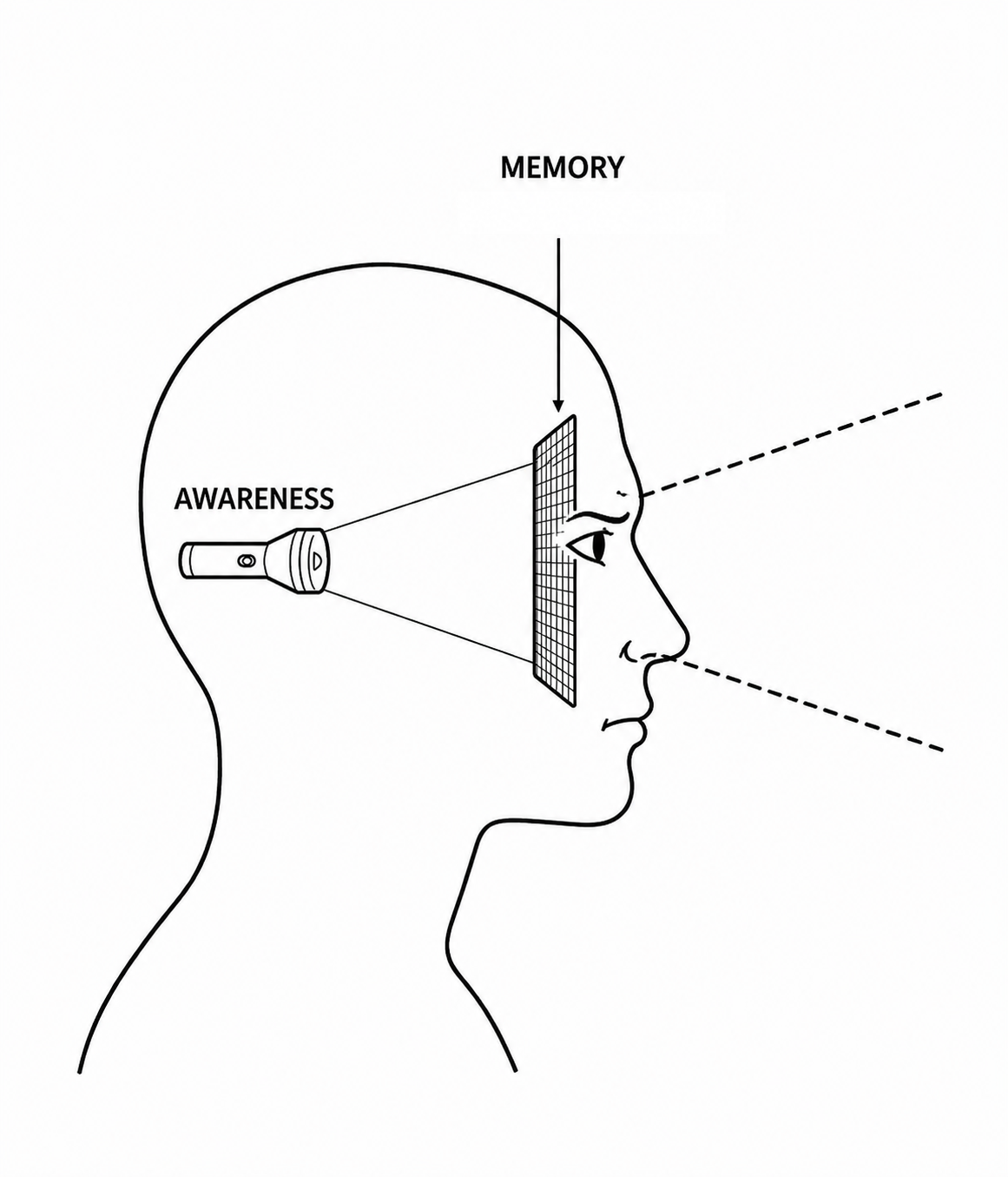
Perception
An insult from years ago can replay in your head over and over again. The vivid detail of what was said, and how it was said, can make it feel like you’re hearing it for the first time. Even when you try, it can be remarkably difficult to erase those words from your mind.
Sometimes the replay turns inward: “Does he really believe that about me? Does everyone? Am I really that bad?” Other times you fight against what was said: “That wasn’t true. He had no right to say that. Why didn’t I defend myself? I should have let him have it.” The argument continues even though the conversation ended years ago.
Physical injuries might heal, but what feels unforgettable is what the mistreatment revealed about how they see you. They acted like you did not exist, did not matter, or somehow deserved what happened.
It is impossible to remember everything that happens. The mind has to select what matters. Insults, mistreatment, humiliation, and pain can acquire unusual importance because they seem to put your self-worth in question, reveal who might be a threat, and indicate what could happen in the future. Shame can keep returning to the question of whether the insult was true. Resentment can keep returning to why it was wrong, unfair, or unanswered. Both can fuel rumination and keep memory fixed on the event.
This is more than simply recalling past events. The faculty of memory keeps impressions of past events available to conscious awareness. These remembered impressions can then influence how present events are interpreted, causing past and present to merge in perception. This is how an event that ended long ago can still feel psychologically present.
Gradually, separate memories are collected into a pattern or narrative. New events can then feel less like genuinely new experiences and more like further evidence of something already established. Previously overlooked details take on new significance because they appear to fit the pattern.
The past becomes more than history. It becomes evidence about events, intentions, and character. It also becomes an alarm for what you should notice, expect, and do in the present. A pattern of mistreatment can begin to feel destined to repeat. Seemingly neutral things, such as an object, place, phrase, or time of year, can bring an old injury back to life. And when other people do not see the connections, they may seem to be overlooking something that feels obvious and undeniable to you.
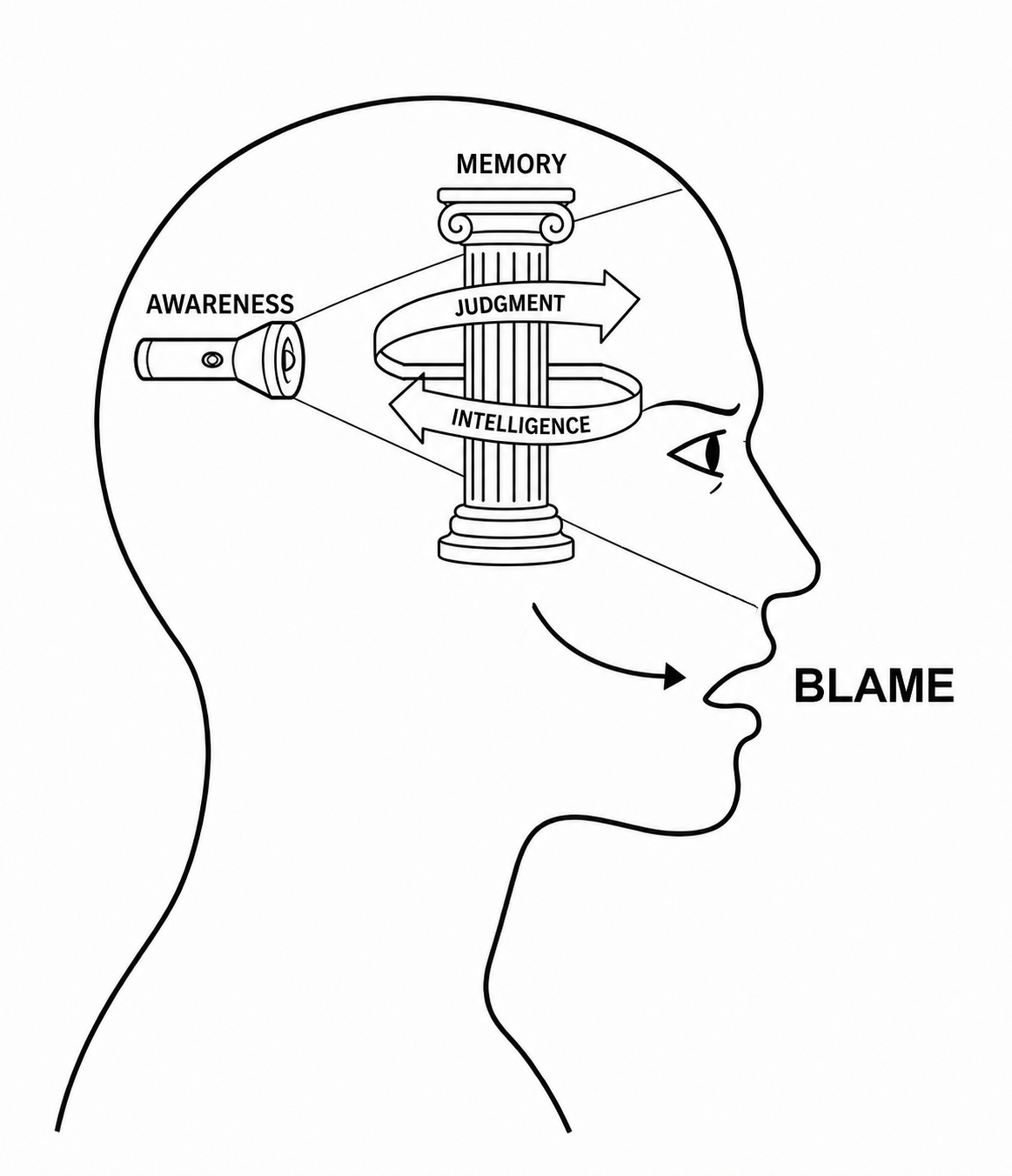
Thought
It is possible to continue an argument with someone in your mind and become more upset with them as a result. This is not just anger. It is a kind of conflict that is only possible after the creation of a mental representation of the perceived offender.
This also happens because of how resentment structures the mind. Judgment and intelligence circle the memory of perceived mistreatment. As they circle, judgment condemns the event as wrong, while intelligence combs the memory for further meaning. Thought may no longer be used only to understand what happened. It can become a way of prosecuting the imagined offender internally.
This internal prosecution becomes stronger when the anger cannot find adequate expression or practical resolution. Fear, dependence, inability, or a concern with factors beyond control get in the way. Anger is then suppressed and becomes active within.
Imagination creates a representation of the person and event inside the mind. Once this representation exists, the story can be rewritten or continued. You imagine what you could have done, how they would have reacted, what should happen next, and what resistance you are likely to face if you try. This kind of imagination allows the mind to continue the conflict internally.
This phenomenon escalates when:
Assumptions are made about the perceived offender’s motives or character.
Moral judgment reduces the person to the offense.
Evidence is accepted or rejected to confirm the preexisting verdict.
Allies are recruited who put loyalty over accuracy, completeness, or nuance.
The verdict is made public through writing, speech, or media.
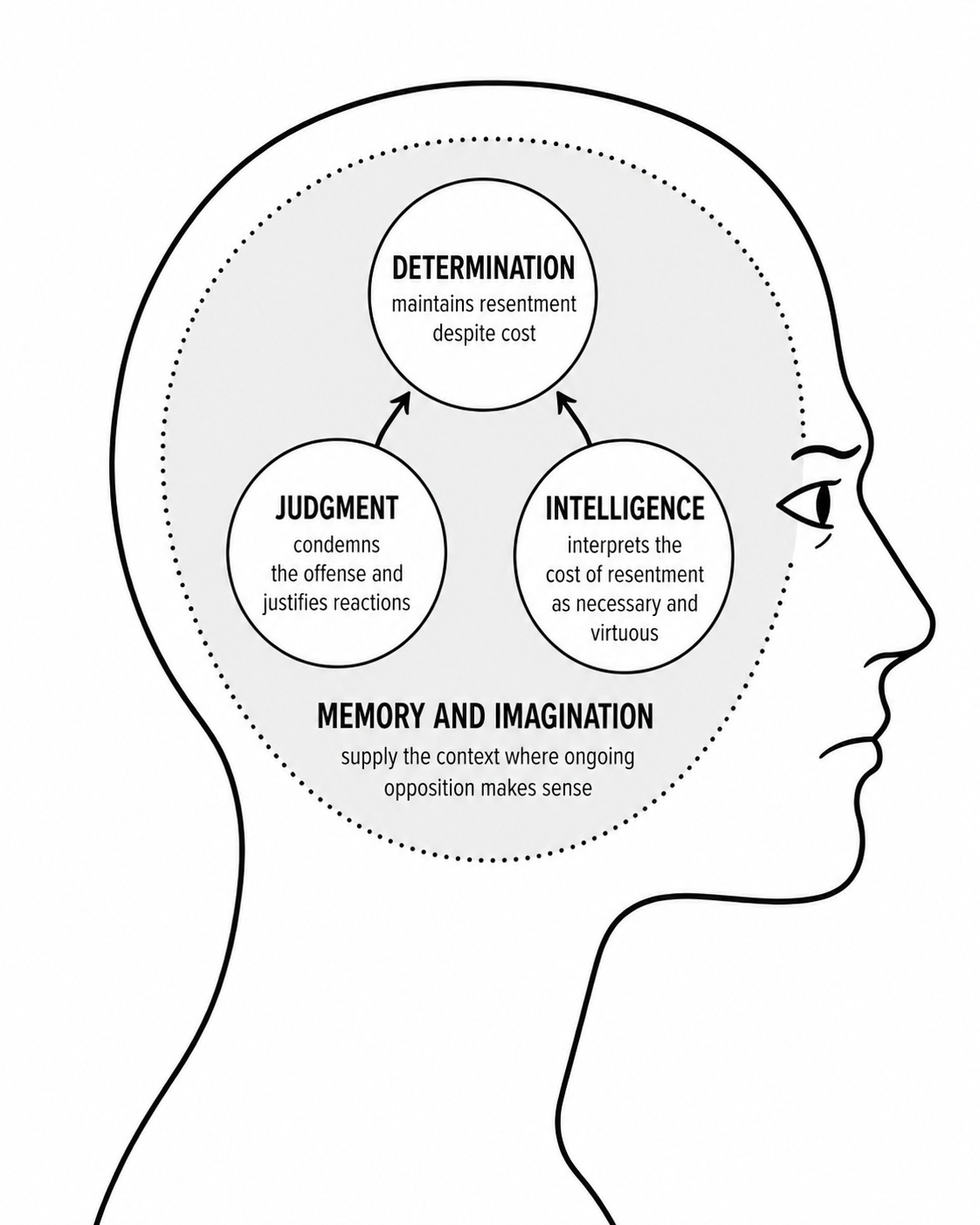
Behavior
In resentment, behavior is organized around responding to a perceived wrong. This can become more important than initiating independent courses of action. The same configuration of the mind that preserves a moral claim can also restrict other forms of agency. As a result, other possibilities for action may gradually be deferred or excluded. Even if the person could repair some of the consequences of the wrong, their demand for justice depends upon the offender or society acknowledging the wrong and bringing it to an adequate resolution.
The behavioral expression of resentment is found as much in inhibition as in reaction. A person may not confront, repair, reconnect, begin something new, or pursue an independent aim because doing so would seem to weaken the unresolved moral claim. At the same time, the actions they do take remain organized around the wrong: opposing it, exposing it, anticipating it, or answering it. They may withhold their feelings even when they have something to say. They may leave some consequences of the wrong unresolved because repairing them before the wrong has been adequately answered would seem to weaken the moral claim. They may continue reacting to what they do not want while gradually losing sight of what they do want.
From the outside, these behaviors can appear self-defeating. From the inside, however, they are experienced as morally necessary. They seem like sacrifices made in the service of truth and justice because moral breaches are expected to be answered for. Forgiving or forgetting before justice has been done can feel like enabling wrongdoing rather than overcoming it.
It takes sacrifice to maintain resentment. Painful moments must be kept vividly present. A person has to resist the pressure of time to render the offense psychologically or morally insignificant. A person also has to resist the apparent indifference or opposition of others. Some aspects of life may need to be put on hold. These sacrifices are reinforced by the perception that past wrongs are still present and that further threats may be impending. Memory and imagination supply the context where ongoing opposition makes sense, even when new mistreatment is not happening in the present moment. Judgment continues condemning the offense as it is remembered, and justifies ongoing resentment amidst the costs. Intelligence interprets the sacrifices of resentment as necessary for maintaining moral integrity.
Most importantly, behavior stemming from resentment follows the momentum of organized perception and thought. Rumination gives certain responses increasing momentum while making others more difficult to choose. At the same time, resentment shapes what seems morally justified or unjustified. Actions are still chosen, but they are chosen from within a range that already feels both psychologically natural and morally valid.
The determination of resentment can become committed to impossible projects:
It seems possible to change the past through a future response.
It seems possible to accomplish through inward struggle what outward action no longer can.
It seems possible to reach another person's conscience through thoughts they cannot hear.
It seems possible to present enough evidence that no one can deny the truth.
Conditions for Release
Under what conditions is resentment resolved and the former owner of this feeling pacified?
To answer this question, we first have to consider an apparent contradiction: Resentment seems to be about fixing a protested condition, but sometimes fixing the condition does not resolve the resentment. There is a simple explanation for this.
Resentment works like a machine to maintain a grievance. And just like any machine, it can be used for secondary purposes. For example, the function of a piano is to sound musical notes. But beyond that, it can also be used for self-expression, developing discipline, making money, worship, and so many purposes. Similarly, holding onto grievances through resentment can serve different secondary purposes, like trying to preserve safety, clarity, or dignity. But depending on what purpose it serves, it’s possible to be oriented either toward resolving grievances—or holding onto them.
There are two types of resentment:
Expectant resentment, where a grievance is treated as a claim awaiting a response.
Entrenched resentment, where grievances are treated as assets to collect, preserve, and use.
These types are not mutually exclusive. It’s possible for a person to pass from one type to the other, or for the two to mix. But since they differ in aim, they also differ in nature.
Let’s look at practical examples of what these types of resentment feel like from an insider’s perspective, and then understand how each experience is shaped by the mind.
Expectant Resentment
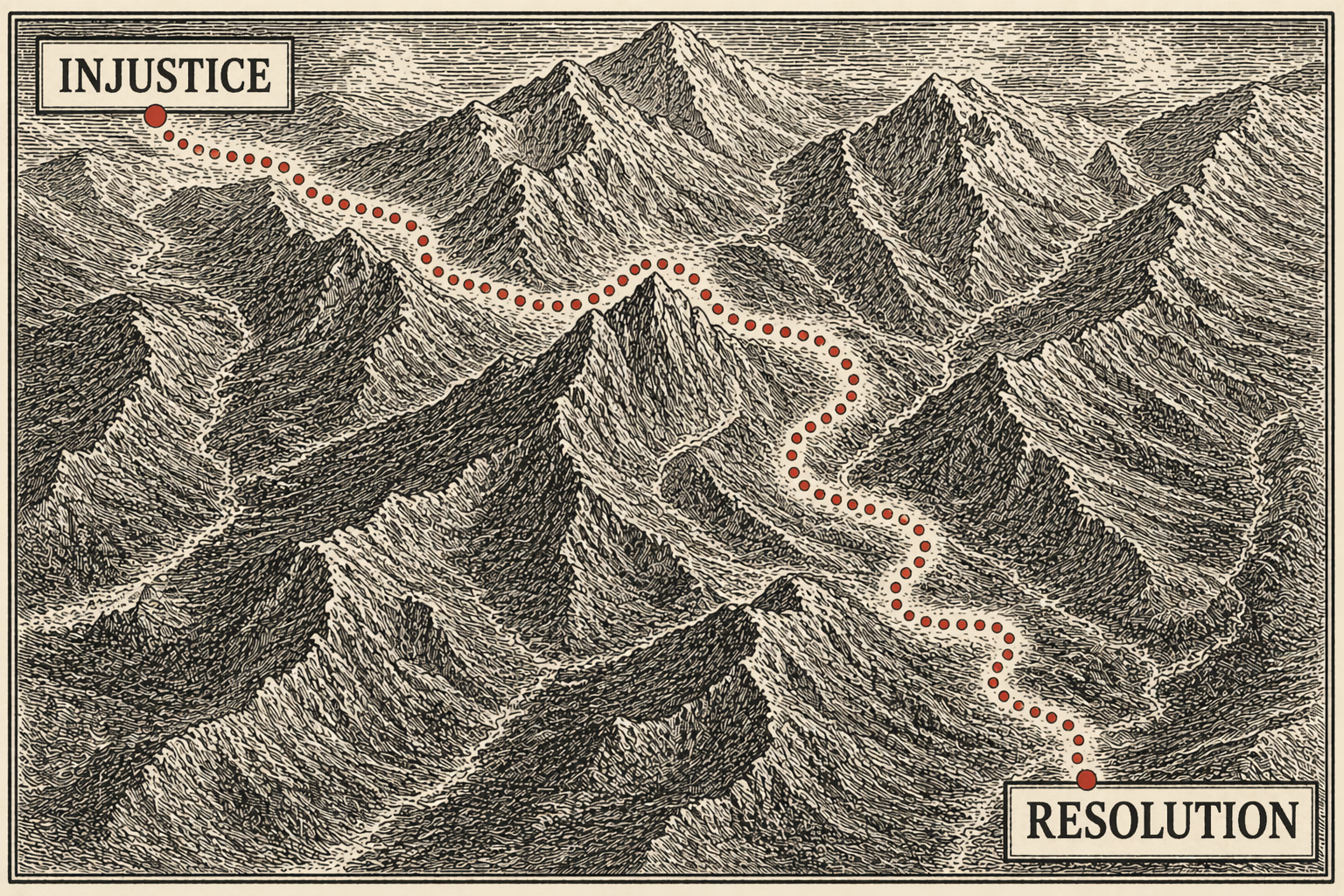
Resentment can be described as “expectant” when a person is oriented toward a concrete outcome that would resolve the wrong to their satisfaction.
This expectation may be realistic or unrealistic, depending on the circumstances.
Realistic Expectation
Adam was demoted for reasons he knows are false. He feels wronged and angry, but also determined that the matter is not settled. He expects to get what he deserves now: acknowledgment, apology, explanation, changed behavior, or justice. These consequences will validate that he did not deserve to be treated this way.
The delay in this response creates mistrust and contempt. “Do they believe those lies? Am I safe with this employer at all? Why did someone else get my job? How would they like it if I demoted them for no good reason?”
Adam is trying to collect his thoughts, plan a response, and take action. He imagines what he could do: confront his boss, write a letter, hire a lawyer, sabotage the company, and so on. He weighs his options and imagines how each one might go. His true feelings are stronger than what he has expressed or done so far, but he hopes his higher-ups will recognize their mistake when he shows them the truth of the matter. They’ve been fair and reasonable in the past, so he has reason to believe the matter can be worked out.
In this example, Adam’s immediate reactions are shock, hurt, confusion, and fear. As resentment takes shape, these reactions fade into indignation and determination. This protects him from receiving the full force of the injury: the humiliation of being wrongly demoted, the loss of proper standing, and the helplessness of being unable to stop what has happened.
But the resentment is not directly expressed. Adam is also feeling anger, suspicion, humiliation, and even some envy. Yet expressing these feelings directly would create more risk. They are therefore suppressed from immediate action or expression while remaining active internally. They circle in his mind, organizing his attention around proving the truth, recovering his position, and obtaining acknowledgment and restoration. Because he still has realistic hope for success, resentment becomes motivation for action. It is preserved internally while action continues externally.
This type of resentment develops when a person feels wronged but still has reasonable hope that the matter can be resolved. The offense remains active because the person expects some answer to the wrong: acknowledgment, explanation, apology, changed behavior, or justice. Anger and indignation may be restrained because direct expression would be unsafe, premature, inappropriate, or strategically unhelpful. But the feelings do not disappear. They are held internally and turned toward preparation, evidence-gathering, planning, and action. In this form, resentment functions as motivation. It keeps the person oriented toward a concrete outcome that would restore dignity, clarify the truth, and confirm that the injury was undeserved.
Unrealistic Expectation
Years ago, Ann’s future inheritance was gambled away by her stepmother, Margo. Now, whenever she struggles financially, she thinks of how there would be a light at the end of the tunnel if not for Margo’s recklessness. But the expectation for her stepmother to apologize, let alone get the money back, has proven impossible. What hurts most is the way it seems like her pain doesn’t matter.
Yelling and arguments don’t change anything. So her anger doesn’t know where to go. So she gets lost in her thoughts and feeings: “How could she have done this? Do I even matter at all? What if I slapped that thief across the face?” Ann doesn’t want her true feelings to come out, so she hides them and tries to be nice when they occasionally talk.
In this example, Ann’s immediate reactions are shock, hurt, grief, fear, and helplessness. As resentment takes shape, these reactions harden into anger, indignation, disgust, bitterness, and the desire for revenge. These feelings protect her from receiving the full force of the injury: the grief of losing what might have protected her, the helplessness of being unable to recover it, the shame of financial struggle, and the pain of feeling that her suffering does not matter.
But the resentment is not directly expressed. Ann is aware of her anger, disgust, contempt, and desire for revenge, but expressing these feelings directly doesn’t change anything. Recognizing this, these feelings are suppressed from immediate action or expression while remaining active internally. Because Ann no longer has realistic hope for resolution, these restrained feelings do not become effective preparation for action. Instead, they are channeled into rumination, bitterness, contempt, and revenge-fantasy.
This type of resentment develops when a person feels wronged and continues to expect acknowledgment, apology, restitution, or justice—even though there is little realistic hope that this response will come. The grievance remains active because the person still feels that something should be answered for, but ordinary action no longer seems effective. Direct confrontation may be useless, unsafe, inappropriate, or already exhausted. As a result, anger and indignation have nowhere practical to go. The need to act is displaced inward, where it circles through memory, judgment, and imagination. The person may replay what happened, condemn the offender, imagine confrontations, or fantasize about revenge. In this form, resentment is preserved not because resolution seems likely, but because the unresolved wrong still feels morally intolerable.
Entrenched Resentment
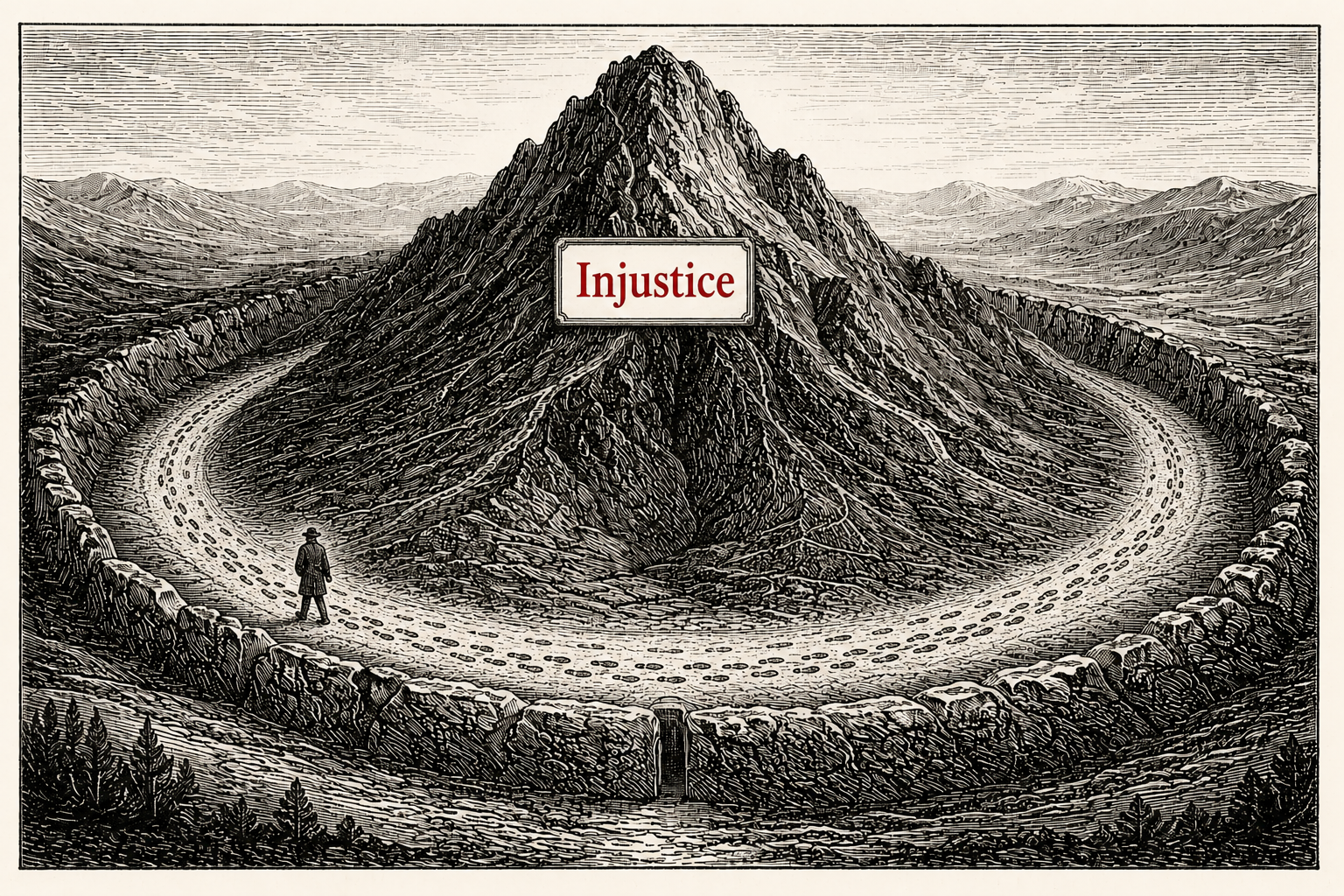
Resentment can be called “entrenched” when the mind treats grievances not as issues to resolve, but as assets to keep and use. This is done to protect other vested interests, such as safety or status.
These grievances can be consistently directed toward a particular person or group, or they can expand and shift targets over time.
Consistent target
Ari couldn’t stand what her ex-husband had done to her. He had cheated and left her for another woman. At first, the wound felt like rejection and humiliation. When she saw pictures of them together, the woman’s faults seemed obvious. “What made her so great?” Ari wondered. She was a marriage-breaker—a shallow, insecure, immoral, and perhaps manipulative person. Justice would be served when people realized this, and she was exposed publicly for what she was. So Ari began a campaign to expose the truth—not just of what happened, but who was who.
The reaction she got was even more infuriating. Her ex-husband cut off contact and became more aggressive in court. Friends who had once tried to mediate became distant. It seemed like everyone had failed her. Telling her story gradually became a test of people’s character: who saw the truth, who protected the guilty, and who could actually be trusted.
Over time, the wound changed shape. Ari was still lonely, but the idea of finding someone new felt dangerous. How could she trust her judgment again? How could she know who was sincere, who was hiding something, or who would betray her later? Her ex-husband was no longer only the person who had rejected her. He became the person who had put her in this position: lonely, guarded, suspicious, and afraid of being humiliated again.
In this example, Ari feels shock, rejection, humiliation, shame, envy, anger, indignation, contempt, need for validation, suspicion, loneliness, and fear. Her moral campaign against her ex-husband and his new partner becomes an active part of her new identity, but without a clear goal that might resolve her resentment. At first, it functions as a shield against vulnerable feelings like rejection, replaceability, and being less desirable. Later, it also functions as a shield against fear, helplessness, and the uncertainty of trusting again.
This type of resentment can protect both status and safety. In the status form, the drive is to restore self-respect by invalidating anyone perceived as a threat to one’s worth or standing. In the safety form, the drive is to restore protection by invalidating anyone perceived as dangerous, enabling, or untrustworthy. In both cases, vulnerable feelings are suppressed, and perceived mistreatment is interpreted morally instead of personally, emotionally, or practically. A person may say something to the effect of, “I’m not affected by what they did. I just want justice.” But to the extent the grievance is not validated by others, the perceived threat remains active in the mind, and the moral campaign must continue.
Practical resolution of specific problems becomes unsatisfying because the aim is no longer only acknowledgment, apology, changed behavior, or legal fairness. The deeper fantasy is that the offender will be forced to internalize the resentful person’s judgment. In the status version, this means the offender must feel ashamed of who they are. In the safety version, it means the offender must be recognized as dangerous, and everyone else must finally take the threat seriously.
Shifting Target
Noah grew up with a father who made jokes at his expense in front of other people. If Noah looked awkward, made a mistake, or seemed too sensitive, his father turned it into entertainment. Everyone laughed, and Noah learned to laugh too. But underneath, he felt exposed, humiliated, and small.
Resenting his father did not feel safe. His father was the one with authority, and Noah still wanted his approval. So instead of openly opposing him, Noah became careful. He learned to read people quickly, avoid disapproval, make others comfortable, and hide anything that might make him look weak. He became agreeable on the outside, but inwardly tense and watchful.
Later in life, the target began to shift. If a coworker teased him, he heard cruelty. If a friend did not respond warmly enough, he felt rejected. If a partner set a boundary, he felt punished. If someone failed to appreciate his effort, he felt used. Each situation seemed different, but each one touched the same old wound: the fear of being made small in front of others.
At first, this resentment protected safety. Noah did not want to be humiliated again, so he tried to notice disrespect early and prevent others from gaining power over him. But it also protected status. When people did not respond the way he thought they should, he felt lowered, ignored, or treated as less important than he deserved.
So the target kept shifting. It was the coworker who joked too casually, then the friend who seemed dismissive, then the partner who did not reassure him, and then the people who failed to recognize how much effort he was making. Each new person seemed to confirm the same hidden claim: people will make me small unless I stay alert, manage their reactions, and resent them when they fail me.
In this example, Noah feels humiliation, shame, fear, anxiety, anger, indignation, contempt, suspicion, bitterness, loneliness, and a need for validation. His resentment no longer depends on resolving one specific conflict. It has become a way of organizing relationships around the danger of being exposed, dismissed, or lowered again.
This type of resentment hinges on the drive to preserve safety and status by continually identifying new threats. The mind suppresses vulnerable feelings like shame, dependence, fear, and the wish to be accepted. These feelings are converted into moral interpretations of others: they are cruel, selfish, dismissive, ungrateful, unsafe, or disrespectful.
Practical resolution becomes difficult because the goal keeps shifting. The resentment must therefore continue, not because one issue remains unresolved, but because the mind keeps finding new people through whom the same hidden threat can be confirmed.
Turning Points
Years spent waiting for justice can change a person. What begins as a justified reaction can grow into an enduring way of organizing life.
This does not necessarily mean that this path is unjustified. Resentment may preserve something important. But preserving it can require sacrifice.
These sacrifices can take different forms:
There can be stress and tension. The fight stays active in the mind and body: vigilance, agitation, exhaustion, restlessness, sleep disruption, or the feeling of always being braced for conflict.
There can be internal conflict. Resentment may make isolation feel safer than connection, silence feel safer than expression, contempt feel safer than vulnerability, and rumination feel safer than peace. What a person wants in one respect may conflict with what feels necessary to protect in another.
There can be lost possibilities. Attention, memory, judgment, intelligence, imagination, speech, and determination are powerful faculties. When they remain organized around an unresolved wrong, they are less available for other purposes: learning, creating, relating, choosing, building, serving, loving, or beginning something new. This does not mean those other purposes are necessarily more important. It means that preserving one commitment can limit what is possible elsewhere.
Resentment can also replace other aspects of identity. It may cease to be only something a person feels and become part of how they understand themselves, other people, and the world. Over time, a person may become increasingly defined by what happened to them, what they oppose, or what they are still waiting for, while other ways of understanding who they are gradually fade into the background.
Over time, the question is not simply whether resentment causes pain or whether the original grievance was justified. The question is what resentment continues to preserve, and whether this purpose is worth the sacrifices required to sustain it.

Resentment Navigator

It can be difficult to navigate resentment. Solutions are not intuitive, while the traps often are. The breakthrough you need does not come from ignoring these obstacles, but by learning how to navigate them effectively.
The Resentment Navigator Program is designed to do exactly that. It will help you understand how patterns of the mind turn into patterns in your life, and what you can do to change this.